What Happens in a Marketing Strategy Session?
Most people who book a marketing strategy session arrive with two things: a vague sense that their marketing isn’t working, and no idea what the next 60 minutes will look like.
That uncertainty is understandable. The term “strategy session” gets used loosely. For some it means a sales call. For others it’s a coaching conversation. What I’m describing here is something more specific: a structured diagnostic that ends with a clear plan.
Here’s exactly what to expect.
What a Marketing Strategy Session Is (And What It Isn’t)
A marketing strategy session is not a sales call dressed up as something more useful. It’s not a coaching session where you spend an hour talking about mindset and leave without a plan. And it’s not a presentation where someone talks at you about what they’d do if they ran your marketing.
It’s a focused conversation designed to surface what’s actually holding your marketing back, and produce a prioritised action plan before you leave.
The session is built around your business, your current situation, and your specific goals. The output is practical, not theoretical.
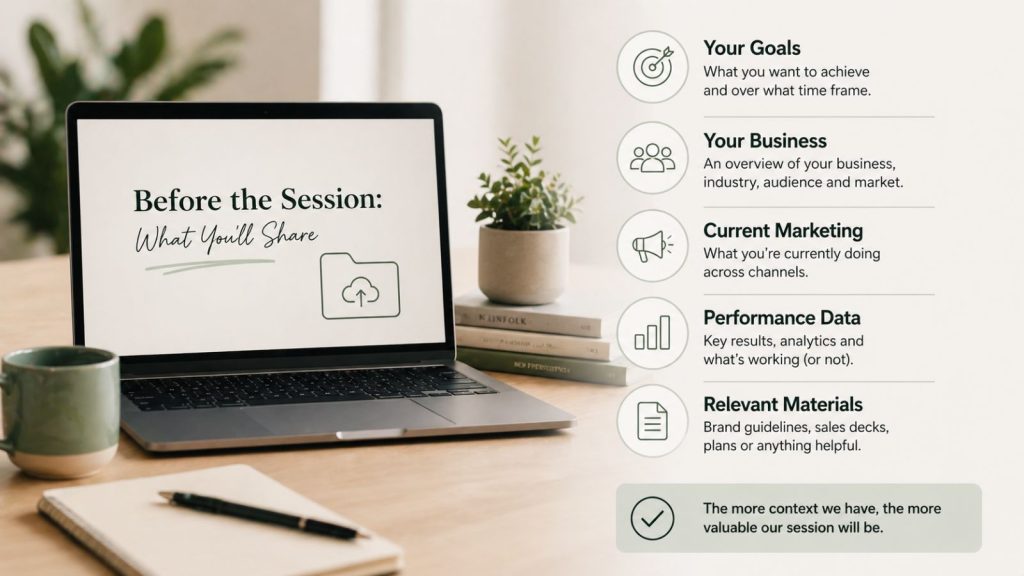
Before the Session: What You’ll Share
A useful marketing strategy session starts before the call.
You’ll typically be asked to share a brief overview of your business: what you offer, who you serve, what marketing you’ve tried, and what results you’ve seen. This takes 10 to 15 minutes to fill in and means the session time isn’t spent on basics.
The more honest you are in this pre-work, the more useful the session becomes. If your messaging is confused, say so. If you’ve wasted money on ads, include that. The goal is diagnosis, not presentation.
During the Session: How It’s Structured
A marketing strategy session typically runs for 60 to 90 minutes and follows a clear structure.
The first part is diagnosis. This is where we look at what you’re currently doing, where the gaps are, and what the data (or lack of it) is telling us. Common issues that come up here: unclear positioning, the wrong audience, or effort spread across too many channels with no depth in any of them.
The second part is prioritisation. Once the diagnosis is clear, the session focuses on what to fix first. Not a list of 15 recommendations, but a ranked list of two or three actions that will have the biggest impact given where your business is right now.
The third part is planning. This is where the diagnosis and priorities become a concrete plan. What specifically are you going to do? On which platform? For which audience? With what message? This part is uncomfortable for some people because it requires making decisions and committing to them. That discomfort is usually a good sign.
By the end, you should be able to answer: “What am I doing for the next 90 days and why?”
What You Leave With
Every marketing strategy session ends with something you can act on.
Specifically, you’ll leave with:
- A clear diagnosis of what’s actually holding your marketing back (often it’s not what you thought)
- A prioritised action list of the two or three things to focus on first
- Clarity on your positioning so you can communicate your offer confidently
- A 90-day direction that tells you what to do, in what order, and what to stop doing
Some clients also receive a written summary of the session, including the key decisions made and the recommended next steps.
What you won’t get is a vague list of suggestions with no clear direction. The point of the session is to leave with less confusion, not more.
Who Gets the Most From a Strategy Session
A marketing strategy session works best for a specific type of business owner.
You’ll get the most from it if you’ve been running your business for at least six months and have some marketing activity behind you, even if that activity hasn’t produced the results you wanted. The session is built around diagnosing what you’ve already tried, so having something to diagnose is useful.
You’ll also get a lot from it if you’re at a decision point: launching something new, changing your positioning, considering investing in ads for the first time, or trying to choose between platforms and feeling stuck on where to focus.
What doesn’t work as well: coming in without a clear business offer, or coming in not ready to make decisions. A strategy session produces a plan. If you’re not in a position to act on one, the session will give you clarity you can’t yet use.
How a Strategy Session Fits Into the Bigger Picture
A single session often does one of three things.
For some business owners, one session is all they need. They get clarity, they have the confidence and capability to execute the plan, and they’re off. For others, the session surfaces enough complexity that ongoing support makes sense, and it becomes the foundation for a longer consulting relationship.
And for some, the session confirms they don’t actually need a consultant. They just needed someone to help them see what was already obvious from the outside.
All three are good outcomes.
For a broader look at what working with a marketing consultant looks like, read how a marketing consultant helps small businesses grow.
Frequently Asked Questions
Is a marketing strategy session worth it for a small business?
Yes, if you’re genuinely ready to act on the output. A strategy session gives you clarity and a plan. That’s worth more than months of unfocused activity. The businesses that get the most value are those who implement what comes out of the session, rather than treating it as a box to tick.
Do I need to prepare anything before the session?
Yes. You’ll be asked to complete a short pre-session brief covering your business, your current marketing, and your goals. This takes 10 to 15 minutes and makes the session significantly more productive. Come ready to be honest about what isn’t working.
What if I’m just starting out and don’t have much marketing history?
A session is still useful, but the focus shifts from diagnosis to foundations. Instead of looking at what went wrong, we’ll build the right structure from the start: clear positioning, the right audience, and a realistic 90-day plan that matches your current stage and resources.
How is this different from a free discovery call?
A free discovery call is a two-way conversation to see if there’s a fit for working together. A strategy session is a paid, focused engagement designed to produce a specific output: your marketing plan. You leave a discovery call knowing whether you want to work with someone. You leave a strategy session knowing what to do with your marketing.
Book Your Marketing Strategy Session
If your marketing feels scattered, you’re unsure where to focus, or you’ve been stuck in the same loop for months, a strategy session gives you a way out of it.
One focused conversation. A clear plan. No ongoing commitment required.
Book your session here and walk away knowing exactly what to do next.