
How a New Ross Shop Owner Could Save 5 Hours a Week with AI Marketing
Picture a clothing boutique in New Ross.
Good stock. Loyal customers. A small but active Instagram following built up over a couple of years. The owner knows her customers, she knows what sells, and she has a genuine knack for the kind of short, conversational posts that her audience actually responds to.
The problem is time. Every Sunday evening, she sits down to plan the week’s content. She writes captions from scratch for three or four Instagram posts. She drafts the monthly email to her customer list. She updates the product descriptions on the two or three new pieces she added to the site that week. It takes four to five hours she does not have, and some months the email does not go out at all.
She knows she is leaving sales on the table. She has looked at AI tools twice before but did not know where to start, tried something too broad, and got back copy that sounded nothing like her. So she went back to doing it herself.
This is one of the most common situations we see with small businesses from New Ross to Wexford. It is not a motivation problem or a knowledge problem. It is a starting problem. And it has a straightforward fix.
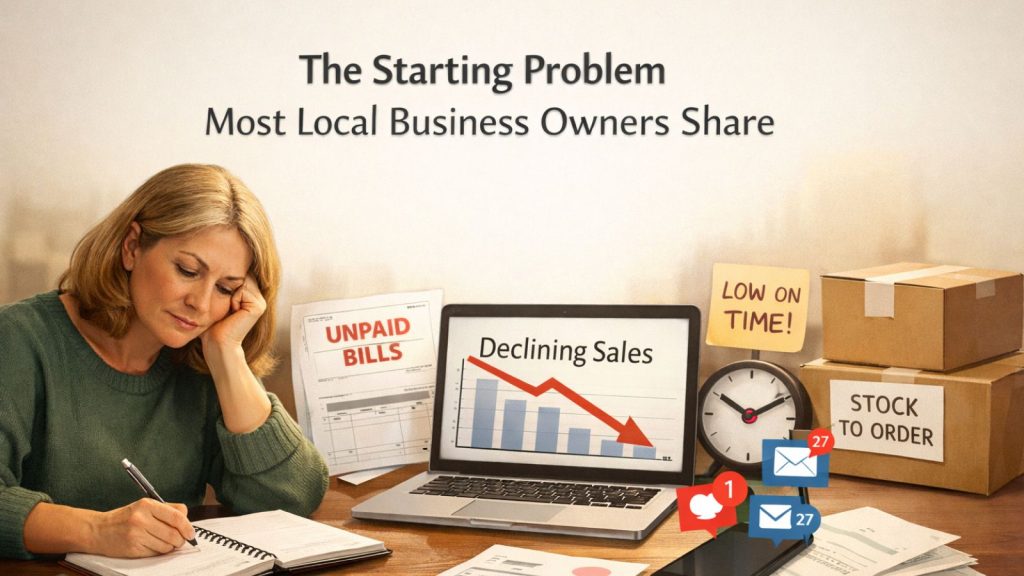
The Starting Problem Most Local Business Owners Share
The owners who build a lasting AI marketing habit all make the same first decision. They do not try to automate everything at once. They pick the single marketing task that costs them the most time and solve only that.
For a boutique owner in New Ross, that task is obvious: it is writing the weekly Instagram captions. It happens every week without fail, it takes longer than it should, and the output varies depending on how tired she is when she sits down to do it.
That is the entry point. Not email, not product descriptions, not her full marketing strategy. Just the captions. Once that runs reliably with AI support, she adds the next task. That is how the habit forms.
The step-by-step guide to starting with AI marketing covers the full framework in detail, including all five entry points and how to choose between them. It is also worth reading how local businesses are using AI marketing across the region.
What Her Week Looks Like With Claude
Claude Pro costs around 20 euro per month. That is the only tool she needs to start.
Here is what her Sunday evening looks like after the first two weeks.
The caption session (25 minutes, replacing 2 hours)
She opens Claude and pastes a brief she built once: the business name, her audience (mostly local women, ages 25 to 55, affordable style), her tone (warm, direct, not salesy), and two or three captions she has written before that she liked. She lists this week’s posts and asks Claude to write a caption for each one in her style. She edits two words in one of them. What used to take two hours now takes 25 minutes.
The monthly email (20 minutes, replacing 90 minutes)
She uses the same brief, adds a note about what is happening this month (a new delivery, an event near South Street, a quiet period she wants to drive footfall through), and asks Claude to draft a 200-word email for her customer list.
She reads it, adds a personal line at the top in her own voice, adjusts one sentence, and sends it. The email that previously got skipped every other month now goes out every month.
Product descriptions (10 minutes per batch, replacing 45 minutes)
When new stock arrives, she jots a few notes: fabric, fit, colour options, occasion. She pastes them into Claude and asks for a 60-word product description per item in her brand voice. Three products done in ten minutes instead of 45.

The Before and After
We have seen this same shift with local businesses from retail shops near South Street and out along the Great New Ross Riverside Walk.
Before:
– 4 to 5 hours per week writing marketing content from scratch
– Monthly email skipped in busy periods
– Product descriptions left thin or delayed
– Inconsistent posting when energy runs low
After:
– Under an hour per week total, including review and editing
– Monthly email goes out every month without fail
– Product descriptions ready the same day new stock arrives
– Posting schedule maintained even during busy weeks
The content does not sound different to her customers. It sounds like her, because she is still the one briefing the tool and reviewing everything before it goes out. The AI handles the blank-page problem. She handles the judgment.
The One Concern Worth Addressing
The most common hesitation we hear from local business owners is: “What if it does not sound like me?”
It will not, at first. The first session with Claude will produce something a bit off. The second session, with better instructions, will be noticeably closer. By week three, once you have saved a brief that includes your tone, your examples, and your audience, the output will need light editing rather than a rewrite.
The rule is: do not judge AI on the first output. Judge it on the output after you have refined the brief twice. That is when you see what it is actually capable of.
The second concern is trust. MarTech research shows only 13% of consumers fully trust AI-generated content. Review everything before it goes out, add your own voice to anything personal, and never publish raw output without reading it. You are not handing the marketing to AI. You are using it to remove the blank-page friction.
Getting Started This Week
Sign up for Claude Pro, write a one-paragraph brief covering your business name, your audience, your tone, and two or three examples of copy you have written that you liked. Pick your most time-consuming weekly marketing task, paste the brief into Claude, describe the task, and read what comes back. Edit lightly and save the prompt that worked.
That is week one. One task, one tool, one saved prompt. The following week you run the same prompt and it takes half the time.
If you are running a business anywhere in New Ross or Wexford and spending more time on marketing admin than on serving customers, the entry point is simpler than it looks. Start with one task. The rest builds from there.
If you would like someone to look at your specific situation and identify where AI can save you the most time, get expert marketing help and we will work through it together.
Frequently Asked Questions
Does this work for a business with no tech background?
Yes. Claude is a chat interface. You type a request in plain English and read what comes back. There is no software to install, no integrations to set up on day one, and no coding involved. If you can write a text message, you can use Claude.
Will my customers know the captions were written with AI?
Not if you review and personalise them before posting. Add your voice, your specific products, and your local references and the content reads as yours. The tool speeds up the drafting. The judgment is still entirely yours.
I am not sure which task to start with. How do I choose?
Pick the task that takes the most time and happens most frequently. For most local retail businesses in New Ross, that is social media captions. For service businesses, it is often email. For hospitality, it is usually responding to enquiries. Start where the pain is biggest and most consistent.
What does it cost to get started?
Claude Pro is around 20 euro per month. There are no other costs required on day one. Canva has a free tier for visual content if you need it. A complete starting workflow costs less than a single hour of outsourced copywriting per month.