Starting a video editing business used to mean competing on hours. You learned the software, you sat at the timeline, and the number of clients you could take was capped by how many nights you were willing to lose. That cap is what kept most people out. The work was never the hard part. The throughput was.
That has changed, and the interesting part is not the editing itself. It is that the price the market pays has not moved much while the time the work takes has collapsed. There are companies selling monthly editing right now, publicly, with a checkout button, and their rate card tells you exactly what a client is willing to spend. This is a breakdown of what a video editing business actually charges, who the buyers are, and how the delivery works when the editing is handled by AI and you handle the judgement.
What the market already pays
The first thing to settle is the price, because everything else in a video editing business is downstream of it. You do not have to guess at this or survey anybody. Productised editing companies publish their rates.
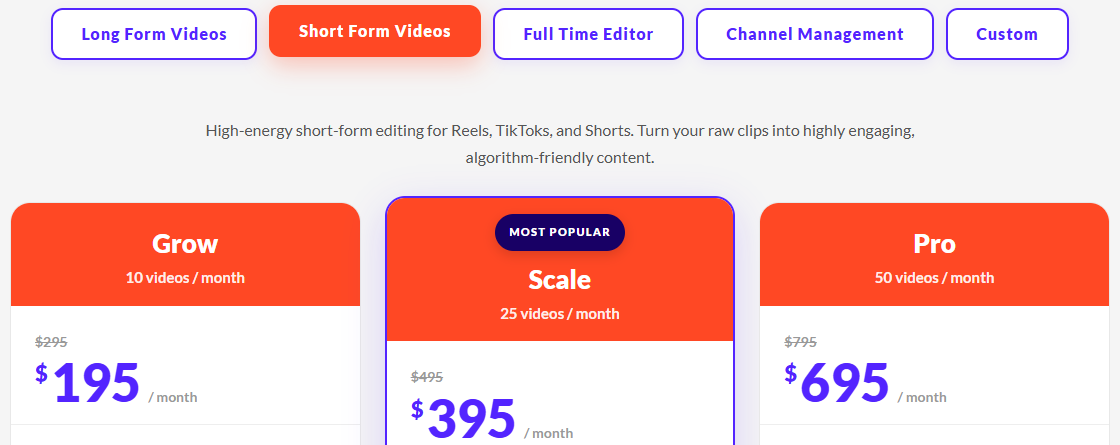
Editvideo.io lists short-form editing at three tiers: 10 videos a month at $195, 25 videos a month at $395, and 50 videos a month at $695. Their long-form ladder runs from $295 for 4 videos up to $995 for 22. A full-time white-label editor, the top of their range, is $2,950 a month.
beCreatives puts the same market at $495 to $2,000 a month depending on turnaround and service level. Two independent companies, broadly the same band.
So the honest answer to what a video editing business charges is roughly $200 to $700 a month per client for a normal volume of short-form work, with the ceiling well above that for dedicated or full-time arrangements. That is the number to hold in your head. Not a projection, not an aspiration, just what the market is already transacting at.
Notice what that price is attached to. It is not attached to an hourly rate, and it is not attached to a single video. It is attached to a defined number of deliverables per month. That structure is doing a lot of work, and it is the structure you want to copy.
Why volume is the thing clients are actually buying
A business does not buy editing. It buys the ability to keep showing up.
Buffer's posting frequency research, drawn from an analysis of their own user base, puts the baseline at 3 to 5 posts a week on Instagram, 2 to 5 on TikTok and 2 to 5 on LinkedIn. Their data also shows that regular posting correlates with roughly five times the engagement of irregular posting.
Run that arithmetic against a real business and the problem becomes obvious. Twelve to twenty pieces a month, every month, produced by someone whose actual work is fixing boilers or running classes. It does not happen. What happens instead is a burst of activity for three weeks, then nothing for two months, then a guilty restart.
That gap is the entire market. A package of 15 pieces a month sits in the middle of the published benchmark, which is why it makes a sensible unit to sell. It is enough to keep an account alive and small enough to deliver reliably.
Finding the clients who need it
There are two routes into this and they work on different timescales.
Cold outreach
The prospect you want has three characteristics: a real business, real customers, and an account they have stopped using. Not a business with no social presence at all, because that one needs convincing the channel matters before they will pay anyone to fill it. You want the business that already believes, already tried, and ran out of time.
Finding them is a search problem. Check local business profiles and their linked social accounts, and read the last post date. That single date does most of the qualifying for you. A business posting five times one week, nothing the next, then ten times the week after is not a business with a content strategy. It is a busy owner doing it in bursts, and a busy owner in a burst cycle is the best prospect in this business.
You can do that search by hand, or you can have a scraping tool like Apify pull the local listings for an industry in your area and assemble the list for you. Either way, the filter is the same and the qualifying signal is the same.
The approach that converts is not a pitch. It is a sample. Take a few clips the business already has, edit one piece properly, and send it to them. You are not asking them to imagine the outcome or trust your taste. You are showing them the finished thing, made from their own footage, before any money is discussed. That was expensive to do speculatively when an edit cost you an afternoon. It is cheap now, and cheap changes the entire shape of the sales process.
One rule if you do this: turn it round fast. If a sample takes you four days, you have quietly demonstrated that your production cannot keep pace, which is the exact problem they are hiring you to solve.
Building your own presence
The second route is slower and compounds. You run the service on your own accounts.
This is the part most people skip, and it is the most defensible asset in a video editing business. Your own feed becomes the portfolio, the proof and the lead source at once. When you approach a business, you are not describing a capability. You are pointing at an account that has published consistently for months, which answers the only question they actually have: can you keep this up?
Cold outreach gets you client one. Your own presence gets you clients three through ten.
How the delivery actually works
The mechanics need to be simple enough that the client's only job is trivial, because the most common failure in this business is not editing quality. It is clients who never send you anything.
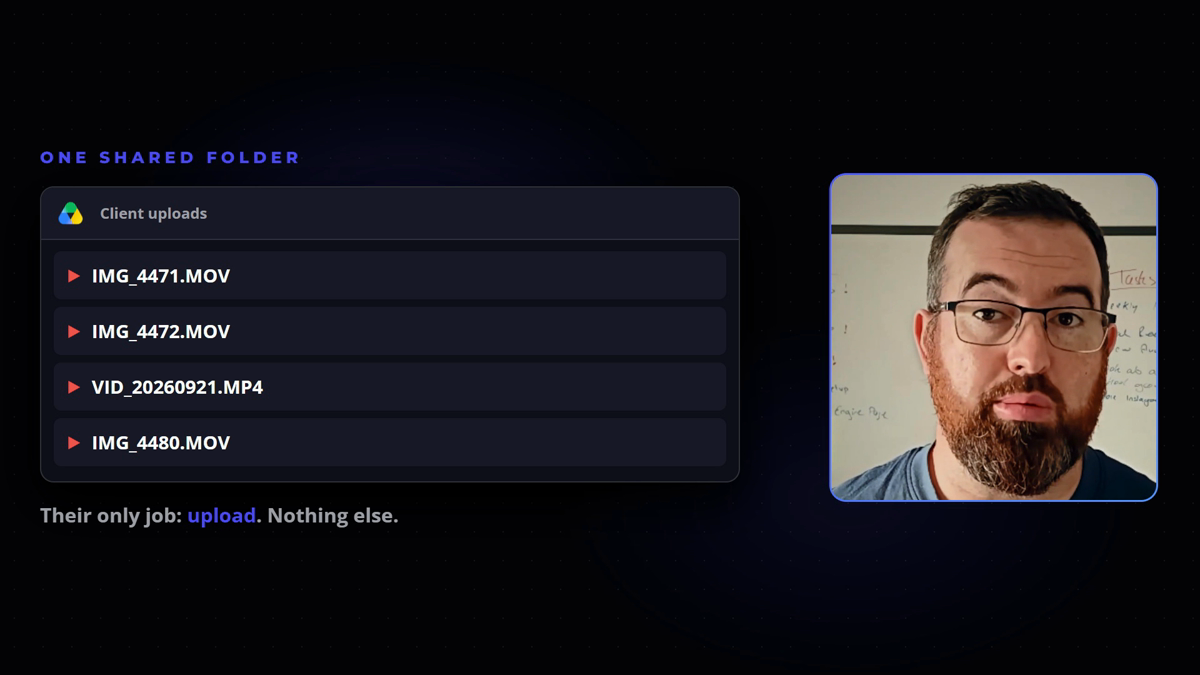
The flow runs like this:
- One shared folder. The client drops their raw clips into a folder you both have access to. That is their whole job, and it is worth saying out loud during the sale, because it is the part that makes them say yes.
- An agreed content plan. You decide what the 15 pieces are for the month rather than reacting to whatever lands in the folder. This is where you stop being an editor and start being worth the retainer.
- The edit. The footage is transcribed, the mistakes and repeats and dead air are cut, and captions, overlays and graphics are applied against a template.
- Review. You watch it. You change the bits that are wrong. This is the job now, and it is the part that cannot be handed over.
- Delivery. Finished files go back, or you schedule them.
Step three is where AI earns its place, and it is worth being precise about what it does. It handles the mechanical work: reading the transcript, finding the repeated takes and the pauses, cutting them out, laying captions and motion graphics against a template you defined. What it does not have is taste. It cannot tell you which take was better, whether a joke landed, or that a section should be cut because it is boring rather than because it is silent. That judgement is the service.
The practical consequence is that you do not need to understand how the models work. You need to be able to look at a finished video and know whether it is good. If you cannot do that, this business will fail for you, and no tool fixes it.
Where the extra margin is
Delivering finished files back to a folder is the base service. The obvious upgrade is scheduling.
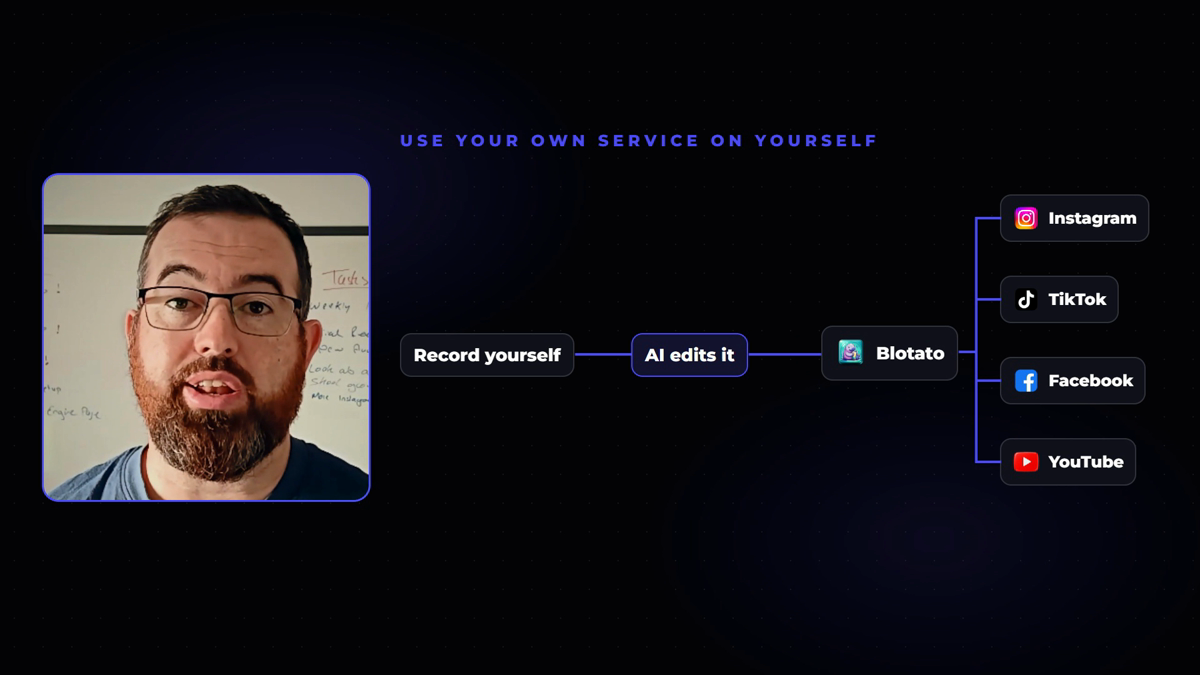
If the client is receiving 15 finished videos and still has to post them, you have handed the last piece of the problem back to the person who has no time. Scheduling the month out for them removes it, and it justifies a higher monthly figure without much extra work at your end. A scheduling tool like Blotato handles multiple client accounts from one plan, so the marginal cost of adding it is small.
The cost side of this business is genuinely light. An AI subscription and a scheduling tool is the bulk of it, and both are priced per month rather than per client, so your costs stay roughly flat as you add clients. That is the part that makes the economics work at a small number of clients rather than needing scale.
One caveat worth stating plainly. If you are handling a client's footage, you are handling their data, and in the EU that makes you their processor. You need an agreement in place, you need to tell them which tools their material passes through, and those tools need to be on business plans rather than personal ones. It is not difficult, but it is the difference between running a business and running a side project that falls over the first time a client asks a serious question.
What goes wrong
Three things, consistently.
Bad input. Rubbish clips produce a rubbish edit. The client's footage is your ceiling and no amount of processing raises it. The fix is upstream: give them a plan, tell them what to shoot, and get some control over what lands in the folder.
Clients who do not upload. This is the real bottleneck and it catches everyone. The editing is never the slow part. Waiting on a business owner to send you their camera roll is.
Expecting it to be instant. Getting a reliable production running took me two to three weeks of mistakes. It edits quickly now, but the setup time is real and nobody selling this idea mentions it.
Frequently asked questions
How much does a video editing business charge per month? Published rates from productised editors sit at roughly $200 to $700 a month per client for short-form volume, with dedicated and full-time arrangements running into the thousands. Pricing per month against a defined number of deliverables is the structure the market already uses.
Do I need to know how to use AI to start a video editing business? No. You need to be able to judge whether a finished video is good. The tools handle the mechanical editing; the taste is what the client is paying for, and that is a normal human skill rather than a technical one.
How many videos should be in a monthly package? Around 15 is a sensible unit. Published guidance puts a business at 3 to 5 posts a week to stay visible, which is 12 to 20 a month, so 15 sits in the middle of what a client actually needs.
How do you find local businesses that need video editing? Look for businesses with real customers and an account they have stopped using. The last post date on their social profile does most of the qualifying. Inconsistent posting, bursts followed by silence, is the strongest signal of a busy owner who needs help.
Does AI replace video editors? No, and it is worth being honest about that. It removes the mechanical work and makes volume possible for one person. It does not supply judgement, taste, or the ability to tell a client their footage is not good enough.
Where to start
The economics here are not complicated. The market pays $200 to $700 a month, the work now takes a fraction of the time it used to, and the clients are visible from a search of your own town. What sits between that and a running business is the delivery: the plan, the folder, the template, and the judgement to check the output before it goes out.
If you want the full production behind this, including the editing setup, the templates and the delivery process, it is all inside The AI Marketing Hub. There is a 7 day free trial to look around before you commit to anything.
Disclosure: Some links in this article are referral links. If you use one, I may earn a commission at no extra cost to you. I only link to tools I actually use.
How this was made: The facts, numbers and examples in this article come from my own work and videos. I use AI to help draft and structure the writing, then I review and edit every line myself before it goes live.

About the author
I'm Wayne St Ledger, and I run St Ledger Marketing. I started out in construction as a plasterer, then went on to a Bachelor's in Marketing and a Master's in International Business, which is where my bias toward results over talk comes from. I help business owners build marketing systems they actually understand, using AI in grounded, practical ways rather than hype. I also run a YouTube channel on marketing and AI, and The AI Marketing Hub, my own community for business owners and marketers putting AI to work properly.