
What would it cost to hire the people who do your marketing every week? I asked that about my own business in November 2026, and the honest answer was just over €80,000 a year. That is after I knocked 20% off on purpose. The AI automation for business that does the same work costs me under €150 a month.
This article shows you the whole thing. The jobs, the hours, the salaries, the sources, the sums, and the parts that are not counted. Then it shows you how to pick the first job in your own business to hand over.
What AI Automation for Business Actually Means
AI automation for business is a set of AI workers that do recurring jobs on a timetable, without you starting them each time. The difference from using ChatGPT is who presses go. With a chat tool, you open it, you ask, you copy the answer, you close it. With automation, the job runs at 06:00 on a Monday whether you are awake or not, and the result is waiting for you.
That distinction matters more than which AI model you use. According to the Small Firms Association, 92% of Irish small firms already use generic tools such as ChatGPT and Microsoft Copilot. Only 30% use customised AI models. In other words, most small businesses have the tool open. Very few have it doing a job.
At the other end, RTÉ News reported a Google-commissioned Amárach survey showing 20% of Irish SMEs use no AI for any business task. About a third of micro-firms with fewer than 10 staff use none. Those are exactly the businesses with no team to hand work to, which is the point of this article.
The AI Village: How I Run My Marketing on One PC
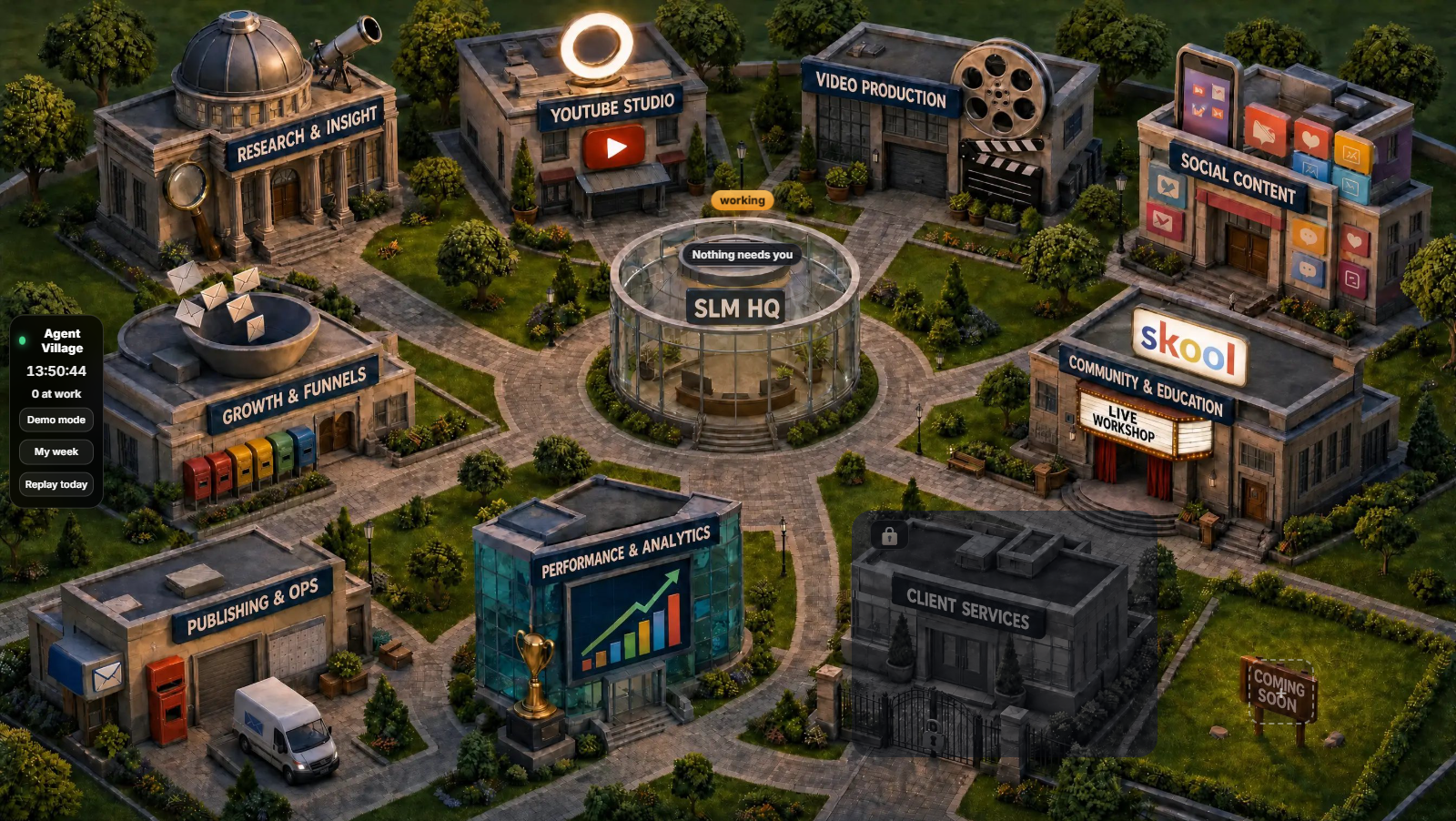
I run St Ledger Marketing, and my marketing runs on what I call the AI Village. It is a set of AI departments, each with a job, that work Monday to Friday on one Windows PC. The PC wakes itself, runs the job, and goes back to sleep. In its first full week, 10 to 17 November 2026, it logged 8,223 actions.
If you want the wider picture of how AI workers differ from plain chatbots, our guide to AI agents for small business covers that ground. Here, I want to stay on the jobs, because the jobs are what you would otherwise pay for.
The Weekly Jobs, Department by Department
- Video editing. On three mornings a week, it edits my raw recordings: one long-form video and up to three shorts per run. It also writes the YouTube title, description and chapters.
- Content planning. It builds the filming sheet I record from, plus the Monday batch of short-form ideas.
- Research. At 06:00 every Monday it sweeps the weekend’s AI news. It keeps a bank of tips, scrapes competitors across Instagram, TikTok and YouTube on Thursdays, and writes idea cards on Friday.
- Numbers. Every weekday it refreshes YouTube, Google Search and link-click data. On Friday it runs a full performance review.
- Community. It builds my Tuesday members’ workshop deck, the Wednesday free workshop page and email, and four community posts a week.
- Social. It builds Instagram story sets on Monday and Thursday, and posts a clip to LinkedIn and Facebook at 11:00 every weekday.
- The Friday brief. At 14:30 on Friday it tells me what happened, what to change, and what to make next week.
As a one-off, it also built four lead magnet pages and the Instagram and Facebook DM automations that deliver them, overnight.
The Tools Underneath It
- Claude Code. Anthropic’s coding agent runs each department. Each job is a written set of instructions (a “skill”) that says what to read, what to produce and what “done” looks like. For example, the video editing skill lists the exact checks a cut must pass before it counts as finished.
- Windows Task Scheduler. This is the alarm clock. It wakes the PC at the set time, starts the job, and lets the machine sleep again once nobody is using it. Nothing runs on Saturday or Sunday.
- Apify. The Thursday competitor sweep uses Apify to pull recent posts from the accounts I watch. The research department then ranks each post against that account’s own average, so it finds the winners and the flops.
- Google Search Console and the YouTube API. These feed the daily numbers. As a result, the Friday review works from real clicks and views, not guesses.
How the AI Team Is Organised
AI automation only holds together if the jobs talk to each other. A pile of separate automations produces a pile of separate outputs. Mine is organised like a small company: departments with clear jobs, a fixed weekly rhythm, and one feedback loop that ends with me making the call. That structure is why it keeps improving instead of repeating itself.
The Feedback Loop
The loop runs once a week, in this order:
- Performance reviews what went out and names the one thing that underperformed.
- Research answers the question that finding raises, using our own data first.
- Ideas become cards, each tied to a goal and a type of reader. The system rejects any card that is not backed by our own numbers.
- I decide on Friday. Each card gets Yes or Not now. That is the only point where content is decided.
- Build happens the following week, for the Yes cards only.
Meanwhile, only two content tests run at once, so I can tell which change caused which result. If you want the full layout of how a system like this fits a small operation, I wrote up how a marketing OS works for a small business.
What I Still Do
I record the videos myself. I approve ideas once a week, and nothing posts without my yes. Everything the video department edits lands in a review file first, never straight into the posting queue.
Pro tip: build the review step before you build the automation. In our experience, the jobs that went wrong early were the ones that could publish on their own. Once every output had to wait for a human yes, mistakes became cheap to catch.
How Much Does a Marketing Team Cost to Do the Same Work?
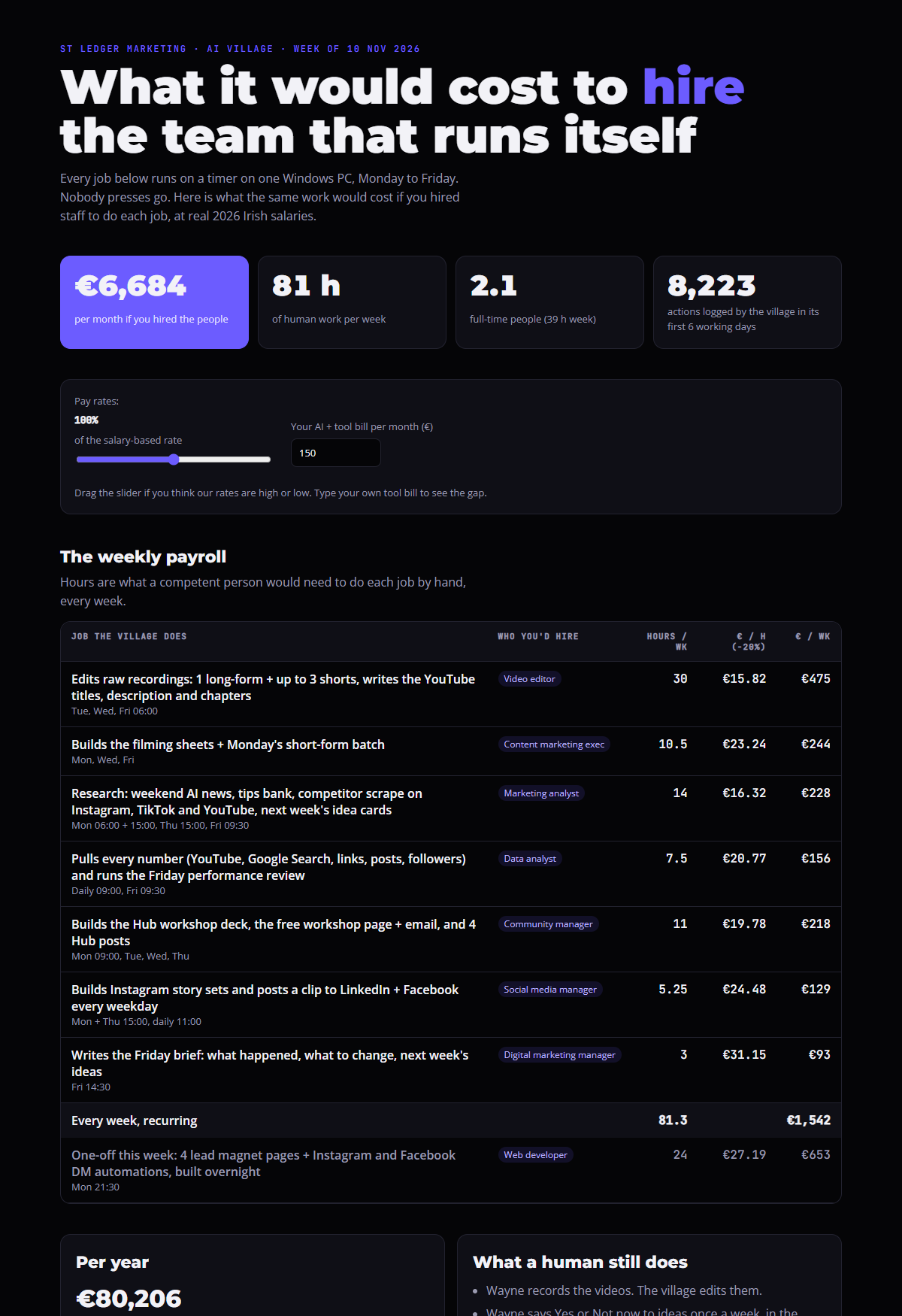
Hiring people to do this work in Ireland would cost about €6,684 a month, or €80,203 a year. That covers roughly 81 hours of work a week, which is 2.1 full-time people. The figure already has 20% taken off. Before that cut it was €100,253. The AI version costs €1,800 a year, so hiring costs about 45 times more.
The Method, Step by Step
The sum is simple, and you can redo it for your own business:
- Match each job to a real role. Video editing maps to a video editor, the Friday brief maps to a digital marketing manager, and so on.
- Take a published Irish salary for that role.
- Add employer PRSI at 11.25%, per Saffery. So the loaded cost is salary × 1.1125.
- Divide by 1,800 productive hours a year to get a loaded hourly rate.
- Cut 20%, because I would rather understate this than oversell it.
- Multiply by the hours per week the job would take a person.
One honest note: the hours per job are my estimate of human time, not a timed study. In addition, Saffery reports the standard employer PRSI rate rose to 11.40% from 1 October 2026. I used the older 11.25%, which nudges the total down slightly.
The Per-Role Table
| Job | Role | Salary used | Hrs/wk | €/h after 20% cut | €/wk |
|---|---|---|---|---|---|
| Video editing + YouTube pack | Video editor | €32,000 (Payscale) | 30 | €15.82 | €475 |
| Filming sheets + Monday short-form batch | Content marketing executive | €47,000 (Prosperity) | 10.5 | €23.24 | €244 |
| Research and idea cards | Marketing analyst | €33,000 (Payscale) | 14 | €16.32 | €228 |
| Daily numbers + Friday review | Data analyst | €42,000 (Payscale) | 7.5 | €20.77 | €156 |
| Workshops, email, community posts | Community manager | €40,000 (Payscale) | 11 | €19.78 | €218 |
| Stories + daily LinkedIn/Facebook clip | Social media manager | €49,500 (Prosperity) | 5.25 | €24.48 | €128 |
| Friday brief | Digital marketing manager | €63,000 (Prosperity) | 3 | €31.15 | €93 |
| Total | 2.1 people | 81.25 | €1,542 |
Where Prosperity gives a range, I used the midpoint. For instance, the video editor figure is the Payscale Ireland median from 18 profiles. The community manager figure is the weakest number here: Payscale holds only two responses for it, last updated in 2021. Treat that row as indicative.
The video editor row is the biggest line by far. If that is the job eating your week, our breakdown of what a video editor costs to hire goes deeper on freelance and employed rates.
For Readers Outside Ireland
The same team costs more in the US. The Bureau of Labor Statistics puts the median film and video editor salary at $75,420. Meanwhile, Payscale puts the average US social media manager at $61,061.
On top of salary, the BLS employer cost survey shows benefits make up 30% of what US private employers pay per hour worked. That is far heavier than Irish PRSI alone.
What Is Not Counted
The €80,203 leaves out several real costs, and all of them push the true figure higher:
- Recruitment fees and time spent hiring
- Holiday and sick cover
- Management time to brief and check the team
- Laptops and software seats for staff
- The one-off lead magnet build
It also leaves out two costs on the AI side. First, the time I spent building the system. Second, my own review time each week, because I approve everything. Those are real hours, and you should expect to spend them too.
The Honest Limits of AI for Business Automation
AI for business automation replaces hours, not judgement. The system drafts, edits, researches and reports, but it does not know which idea fits my business this month. That is why every decision lands on my desk on Friday. Quality still needs a human reading the output, and anyone who tells you otherwise is selling something.
There are three limits worth naming plainly:
- It needs a clear brief. A department with a vague job produces vague work. Each of mine has a written definition of done.
- It needs your data. The research and ideas are only as good as the numbers feeding them. In the first weeks, the data was thin, and the recommendations were weaker for it.
- It does not replace the person on camera. I still record every video. The system edits what I give it.
Furthermore, the 45x comparison is not a claim that you could fire a team tomorrow. It is a way to see how much work is sitting in your week, and what it would cost if you paid someone for it.
How to Start: Pick Your First Job to Automate
The best first job to automate is one that runs on a timetable, follows the same steps every time, and produces something you can check in two minutes. Do not start with your whole marketing. Start with one job, get it reliable, then add the next. Here is the order I would follow.
- List your recurring jobs for one week. Write down everything you do more than once: posts, reports, emails, research. Put a rough hour count beside each. This takes about 30 minutes.
- Price them. Use the method above. Even rough numbers show you where the money is.
- Pick the job with the clearest “done”. A weekly numbers report is a strong first choice, because you can tell at a glance whether it is right.
- Write the instructions down. List what the AI reads, what it produces, and what a good result looks like. Treat it like briefing a new hire.
- Run it by hand for two weeks. Start it yourself each time and check every output. Fix the instructions, not the output.
- Then put it on a timer. Only once it is reliable does it get a schedule, through Windows Task Scheduler or similar.
- Add a review step. The output waits for your yes. Nothing goes public on its own.
Pro tip: your second job should feed off your first. My numbers job came first, and the research department was built to read its output. As a result, each new job made the existing ones more useful, rather than adding another separate tool to check.
FAQ
What is AI automation for business?
AI automation for business is using AI to do recurring jobs on a schedule, without you starting them each time. Examples include editing video, writing weekly reports, researching competitors and drafting social posts. The key difference from a chat tool is that the job runs on its own, and a person reviews the result before anything goes out.
How much does a marketing team cost in Ireland?
Covering the 81 hours of weekly marketing work in this article would cost about €80,203 a year in Ireland. That uses published Payscale and Prosperity salaries, adds 11.25% employer PRSI, and then cuts the result by 20%. Before the cut it is €100,253. Recruitment, holiday cover and management time are not included, so the real figure is higher.
Do I need to know how to code to set this up?
No, you do not need to write code from scratch. Tools such as Claude Code write and run the scripts from plain-English instructions. However, you do need to describe each job clearly, test it by hand, and review its output. That is a skill you learn, and it is closer to managing a person than to programming.
Can AI automation replace my marketing staff?
Not fully, and it should not try. AI automation handles the repetitive production work: editing, research, reports and drafts. It does not replace judgement about what your business should say, or the person on camera. The realistic outcome is that one person does the work of a small team, with a human checking every output.
Build Your Own AI Team, One Job at a Time
You now have the jobs, the hours, the method and the honest limits. The next step is building the first department in your own business. Inside the AI Marketing Hub, I show members how I built each part of the AI Village, step by step, in the weekly workshops. It is a paid membership, and you can start with a 7-day free trial to see whether it fits before you pay anything.
Disclosure: Some links in this article are referral links. If you use one, I may earn a commission at no extra cost to you. I only link to tools I actually use.
How this was made: The facts, numbers and examples in this article come from my own work and videos. I use AI to help draft and structure the writing, then I review and edit every line myself before it goes live.

About the author
I’m Wayne St Ledger, and I run St Ledger Marketing. I started out in construction as a plasterer, then went on to a Bachelor’s in Marketing and a Master’s in International Business, which is where my bias toward results over talk comes from. I help business owners build marketing systems they actually understand, using AI in grounded, practical ways rather than hype. I also run a YouTube channel on marketing and AI, and The AI Marketing Hub, my own community for business owners and marketers putting AI to work properly.