
A video editor costs somewhere between €900 and €2,500 a month on a retainer, or roughly €260 per video if you buy them one at a time. Those are the numbers I was quoted, and they line up with what the market publishes.
I stopped paying one anyway. Over the last sixty eight days I published fifty pieces of content, long form and short form. At the going rate that would have been about thirteen thousand euro. I spent under sixty euro a month instead.
Before that turns into an argument about AI replacing people, it is worth saying plainly: video editors are worth what they charge. If you can afford one, hire one. A good editor will beat my setup on quality and they will spot things I never will. What follows is not a case against editors. It is the actual arithmetic for a small business that publishes every week and cannot absorb either the invoice or the wait.
How much does a video editor cost per video?
Per video is the number most people search for first, so start there.
The published tiers are fairly consistent across the market. goLance puts freelance video editors between $15 and $150 an hour depending on experience, with mid level editors averaging around $58. Content Beta breaks the same market down by deliverable rather than by hour.
Converted to euro and grouped by what you actually get:
| Tier | What it buys | Approx cost per video |
|---|---|---|
| Beginner | Basic cuts, titles, simple transitions | €9 to €34 |
| Standard | Talking head or vlog edit, captions, music | €26 to €129 |
| Professional | Retention edited long form, graphics, colour | €171 to €514 |
| Agency | Multi camera, motion design, full production | €429 to €1,715+ |
The market average for a single YouTube video in 2026 sits at roughly €261. The Creators Assistant puts the typical freelance project range at $300 to $1,500, which is €257 to €1,286.
So if someone quotes you €250 for a properly edited ten minute video, they are not overcharging you. That is the middle of the market.

How much do video editors charge per month?
Here is the part that catches small businesses out. You will rarely be quoted per video. You will be quoted a retainer.
Vidico publishes subscription editing packages at $500 to $2,500 a month for a defined volume. A small business social retainer covering four to eight short form deliverables a month typically lands at $1,000 to $3,000, which is roughly €857 to €2,571.
That is the row that matters. Four to eight pieces a month. Not four to eight a week.
Put that against a weekly publishing schedule and the maths gets uncomfortable fast. If you are posting five times a week, you need somewhere north of twenty pieces a month. A retainer built for eight does not stretch to twenty by paying a bit more. You end up needing multiple editors, which multiplies the briefing, the chasing and the inconsistency.
For my fifty pieces, at the €261 market average, the bill would have been about €13,050.
Why the hourly rate is the wrong number
Most cost guides lead with an hourly rate, and it is the least useful figure of the three.
Rates vary enormously by region. ReelRate puts Western European editors at $30 to $110+ an hour, the UK at $25 to $120+, and Eastern Europe at $15 to $55. UK day rates run £250 to £450.
There is no published Ireland specific rate. I looked, and two separate rate guides do not break Ireland out. Western Europe and the UK day rate are the honest proxies, and I would rather say that than invent an Irish figure.
But the deeper problem is that an hourly rate tells you nothing about your total cost, because the editor's hours are not the only hours involved. Yours are in there too, and nobody puts those on the invoice.
The cost nobody quotes you: turnaround
This is the number that actually made me stop, and it is not a cost at all. It is a calendar.
Standard turnaround for most social formats is three to five business days. Increditors publishes economy tiers at five to seven days and premium at one to three. Then the overhead stacks on top:
- One to two days for each revision round
- One day for your own approval cycle
- Two to three hours writing the brief, per video, every time

So the realistic round trip from sending footage to holding a file you would actually publish is five to eight calendar days. That is per video.
Doubling your budget does not shorten a revision round. That is the bit that took me a while to accept. I kept treating it as a money problem and it was never a money problem.
And if the editor leaves, you stop. Twine covers the hidden costs of freelance hiring that never appear in a quote: vetting, onboarding, the test edits, the management time. Replacing an editor and getting them up to speed takes weeks, and your schedule is stopped for all of it.
What doing it yourself actually costs
Most people reading a cost guide are not really choosing between two editors. They are deciding whether to keep doing it themselves.
So price that honestly. The published editing ratio is thirty to sixty minutes of editing per finished minute of video. For YouTube style content with b-roll, music and graphics, Tasty Edits puts it closer to the top of that range.
A ten minute video is therefore five to ten hours of work. With colour, audio and graphics, eight to fifteen.
One weekly video edited by hand is a full working day, every week, forever. My fifty pieces would have been roughly forty working days inside a sixty eight day window. It was not that doing it myself was expensive. It was that it was not physically possible.
Put your own hourly rate against that and doing it yourself becomes the most expensive option on the table. You just never get an invoice for it, so it does not feel like one.
What an AI editing stack costs
My whole stack is under sixty euro a month. Two tools.
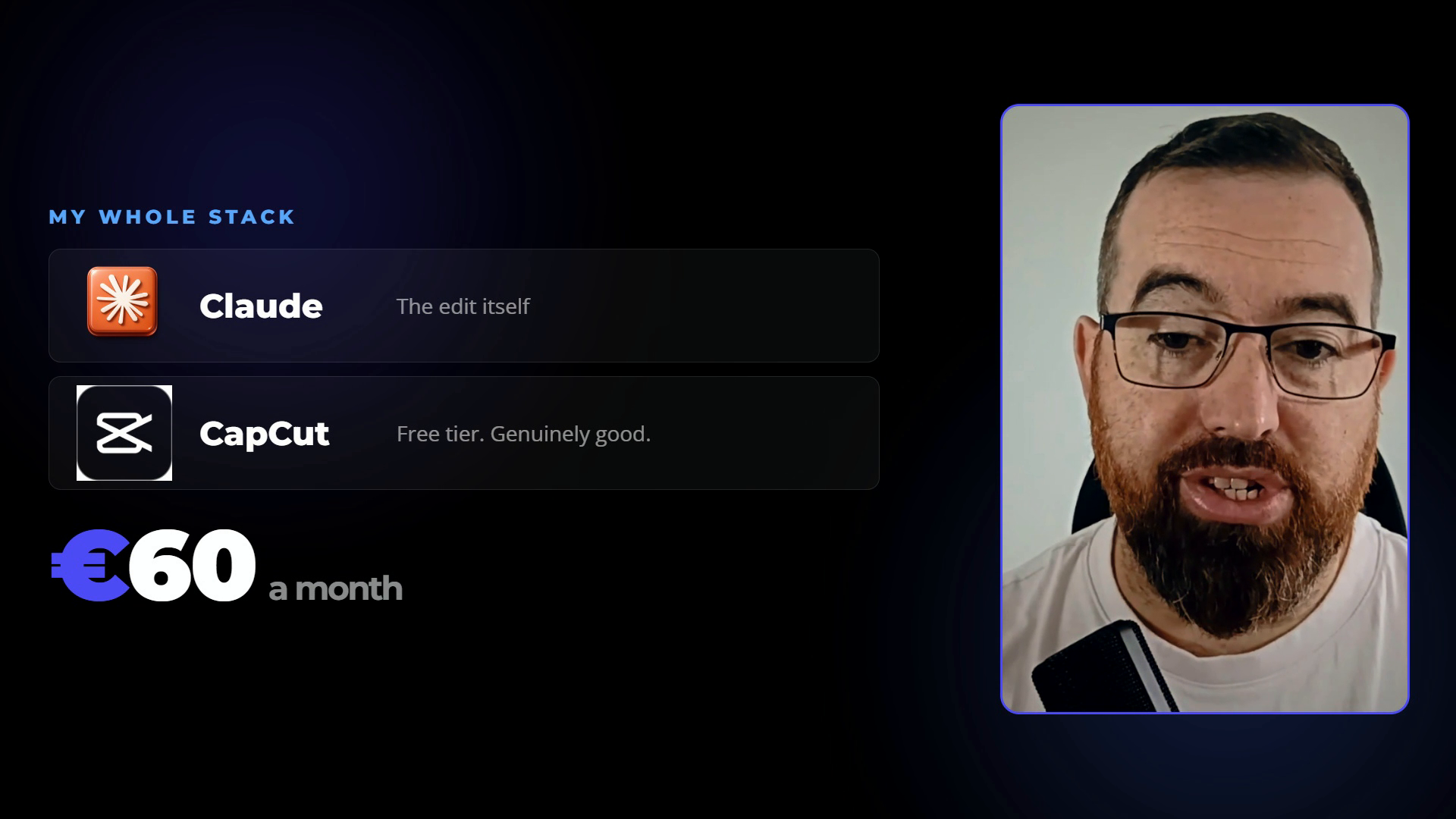
Claude does the actual editing decisions. I record the video, then it takes the recording, works out the talking points and the angle, breaks the whole thing into chapters, and cuts it. I say the cut points out loud while recording, things like "start chapter one" and "end chapter one", and it uses those markers to snip the video. That trick is the thing that makes it work, and it costs nothing to adopt.
CapCut handles the bits I still touch by hand. Worth being clear here: the free tier is genuinely good. If money is your only constraint, start there and do not spend anything.
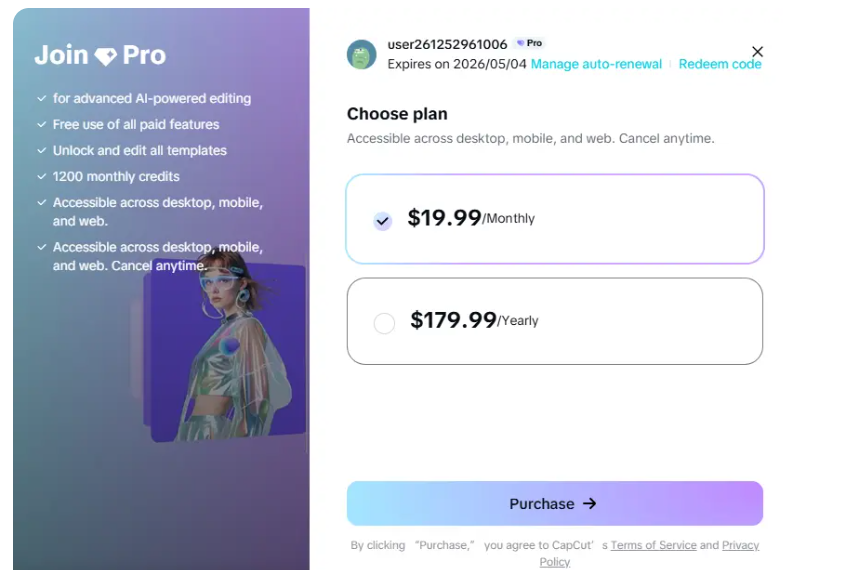
Across fifty videos that works out at roughly €1.20 to €2.40 per finished video.
I want to be honest about one thing: my stack is not the cheapest available. The commonly published creator stack of Descript plus OpusClip runs about €10 to €26 a month, which is less than I pay. I did not find the cheapest option. I found the one that fits how I work, and I would rather say that than pretend I optimised for price.
Where AI video editing falls over
A cost comparison that only shows the good side is an advert, so here are the two places mine genuinely breaks.
It has no taste. Whatever you tell it is good, it decides is good. If I tell it every graphic should be a pink card on the left of the screen, it will do exactly that, perfectly, every time. A human editor would tell me that looks terrible. AI never will. You end up building a system around your own preferences, which may not be what your audience actually responds to.
You still finish it yourself. There is a real gap between "the AI cut it" and "this is publishable". For me that gap is about ten minutes of hands-on work per video. Small, but not zero, and anyone telling you it is zero is selling something.
One distinction worth drawing, because the AI channels blur it constantly. Generating a video from a text prompt and editing footage you actually filmed are two different products with two different reliability levels. I film real footage and the AI cuts it. I am not prompting videos into existence and I would not advise it.
So which one should you pick?
Three options, real numbers, side by side.
| Editor | Yourself | AI stack | |
|---|---|---|---|
| Cost for 50 videos | ~€13,050 | €0 in cash | Under €60/month |
| Your time | Briefing and review | 40+ working days | ~10 min per video |
| Turnaround | 5 to 8 days | However long you have | Same day |
| Quality ceiling | Highest | Yours | Between the two |
Hire the editor if you publish once or twice a month and can comfortably spend €500 to €2,500. You will get a better video than mine and the five to eight day round trip genuinely does not matter at that volume. Go and do that.
Use an AI stack if you are publishing weekly or daily on a small business budget. That editor option was never really open to you, and the calendar is the reason, not the price.
The thing that settled it for me is the part that compounds. An editor relationship resets to zero the day they leave, and you start again teaching the next person what you like. Hours you spend editing by hand are simply gone. A system you tune gets slightly better every video, because every time it broke I fixed the system instead of the video.
Video is not optional for small businesses any more, which is exactly why the cost question matters. The answer is not that editors are overpriced. It is that most small businesses are solving a calendar problem with a budget, and it does not work.
If you want to build the same setup rather than work it out from scratch, that is what I walk through step by step inside the AI Marketing Hub, which has a seven day free trial to start.
FAQ
How much does a video editor cost per hour? Between $15 and $150 depending on experience and region, with mid level editors averaging around $58. Western Europe runs $30 to $110+, Eastern Europe $15 to $55. UK day rates are £250 to £450.
How much does a video editor cost per video? The 2026 market average for one YouTube video is about €261. Basic cuts start around €9 to €34, standard talking head edits run €26 to €129, and professional retention edited long form is €171 to €514.
How much do video editors charge per month? Retainers run €857 to €2,571 a month for four to eight deliverables. Dedicated short form subscriptions start around €253 to €681. A full time offshore editor is €1,543 to €2,571.
How long does a video editor take? Three to five business days is standard, plus one to two days per revision round and a day for your own approval. Realistically five to eight calendar days per video from sending footage to a publishable file.
Is it cheaper to edit videos yourself? In cash, yes. In time, no. At thirty to sixty minutes of editing per finished minute, one weekly ten minute video is a full working day every week. Priced against your own hourly rate, it is usually the most expensive option.
Can AI replace a video editor? Not for quality or judgement. AI has no taste and will follow bad instructions perfectly. It can replace video editing as a task for a small business that cannot afford to outsource on either money or time, which is a narrower claim and a more honest one.
Disclosure: Some links in this article are referral links. If you use one, I may earn a commission at no extra cost to you. I only link to tools I actually use.
How this was made: The facts, numbers and examples in this article come from my own work and videos. I use AI to help draft and structure the writing, then I review and edit every line myself before it goes live.

About the author
I'm Wayne St Ledger, and I run St Ledger Marketing. I started out in construction as a plasterer, then went on to a Bachelor's in Marketing and a Master's in International Business, which is where my bias toward results over talk comes from. I help business owners build marketing systems they actually understand, using AI in grounded, practical ways rather than hype. I also run a YouTube channel on marketing and AI, and The AI Marketing Hub, my own community for business owners and marketers putting AI to work properly.