
AI Content Workflow Guide (2026): Build Custom Systems Fast
This guide shows you how to build a repeatable AI content workflow in under an hour. Once set up, you’ll create content in 30 minutes that previously took half a day.
Prerequisites
Before starting, ensure you have:
– Access to any AI writing tool (ChatGPT, Claude, Gemini, or similar)
– 3-5 examples of your existing content that reflect your brand voice
– A list of topics your customers ask about regularly
– 60 minutes for initial setup (future content takes 30 minutes or less)
Step 1: Define Your Content Pillars (10 minutes)
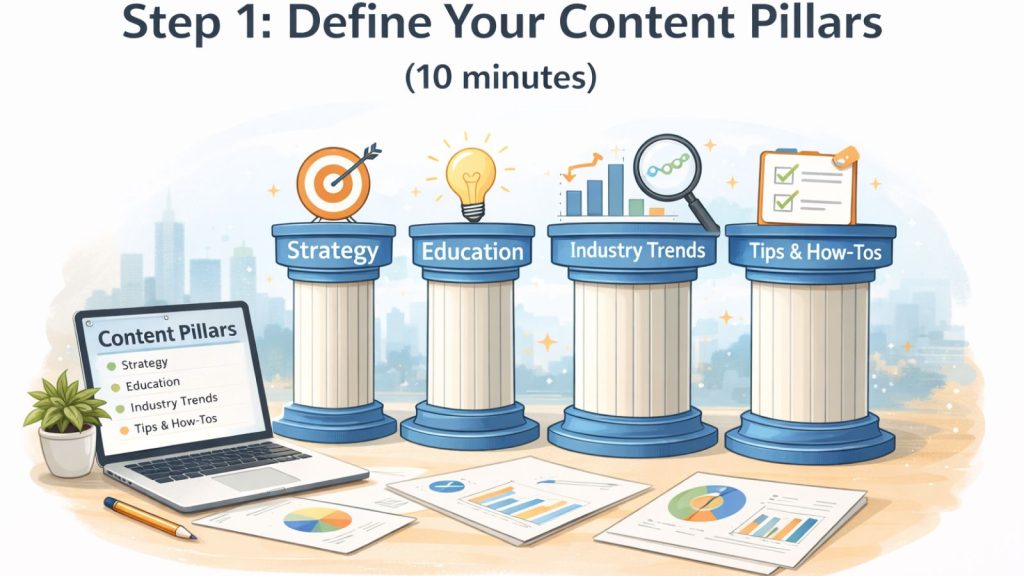
List the 3-5 core topics your business covers. These become your content pillars the categories every piece of content falls under.
For a marketing consultancy, pillars might include: AI marketing, social media strategy, email campaigns, local SEO, and content creation. For a café, they might include seasonal menus, local suppliers, behind-the-scenes access, and community events.
Write one sentence describing each pillar and the questions your customers ask about it.
Pro tip: Your most common customer questions are your best content topics. Check your inbox and social messages for patterns.
Step 2: Create Your Brand Voice Document (15 minutes)
AI tools write generic content by default. Your brand voice document fixes this.
Gather 3-5 pieces of content you’ve written that sound like emails to customers, social posts that performed well, or about page copy. Paste these into a document.
Add instructions that describe your voice:
– Tone (professional, friendly, direct, casual)
– Words you always use
– Words you never use
– Typical sentence length
– How you address customers (you, we, they)
Step 3: Build Your Content Brief Template (15 minutes)
Create a reusable template that tells the AI exactly what you need. Include:
1. Topic: What the content covers
2. Content pillar: Which category it belongs to
3. Target reader: Who this is for and what they need
4. Key points to include: 3-5 facts or messages
5. Call to action: What you want readers to do next
6. Word count: Your target length
7. Brand voice reference: Link to your voice document
Save this template. You’ll reuse it for every piece of content.
Step 4: Run Your First Content Generation (10 minutes)
Open your AI tool. Paste your brand voice document as context. Then paste your completed content brief for one topic.
Ask the AI to generate a first draft. Review it against your brand voice does it sound like you? If not, give specific feedback: “Make it more conversational” or “Use shorter sentences.”
Iterate until the output matches your expectations. Save the final prompt as your master template.
Step 5: Establish Your Review Process (10 minutes)
AI-generated content needs human review. Create a simple checklist:
– [ ] Does it sound like our brand?
– [ ] Are facts accurate?
– [ ] Is the call to action clear?
– [ ] Would I be proud to publish this?
For how local businesses in Wexford are using AI, content that once took a full afternoon now happens before lunch.
Common Mistakes to Avoid
1. Skipping the brand voice step: Generic AI content damages trust. Invest the 15 minutes.
2. Accepting first drafts: AI gives you a starting point, not a finished product.
3. Overcomplicating the process: Start with one content type before expanding.
4. Forgetting to update your voice document: As your brand evolves, so should your AI instructions.
How long before I see time savings?
Most businesses see immediate savings on their second piece of content. The workflow improves with each use as you refine your prompts.
Does this work for any industry?
Yes. The framework applies to any business creating written content, blogs, emails, social posts, product descriptions, or customer communications.
Your Next Step
You now have a framework that works with any AI tool. New to marketing overall? Our marketing tips for startups cover the foundations before layering in AI automation.
Content that took hours now takes minutes. The workflow is set. Start creating.
Still not sure? Then make sure you join The Marketing Hub of like-minded business owners, all looking to use AI in their businesses.