Most guides on how to create a faceless Instagram account are written by someone who already has one working. You get the finished version, the follower count, and a tidy explanation of why it was always going to work. What you never get is the part where somebody sits down with nothing and decides what the account is actually for.
I am writing this on day one of doing it myself. Three new accounts, no followers on any of them, no results to show you. What follows is the decision process, not a victory lap, and you can check it against whatever happens next.
What a faceless Instagram account actually is
A faceless account is one where nobody is on camera. The content carries the value instead of a personality: text on screen, screen recordings, stock footage, generated images, and a voice over the top. It is sometimes called a theme page, because the page is about a theme rather than a person.
The reason people reach for it is obvious. You do not have to film yourself, so you can run more than one account, and you can produce content on days when you would never put yourself in front of a camera.
The reason most of them fail is also obvious once you see it. Without a face, there is nothing holding the account together except the topic. So the topic has to be narrow enough to be a promise.
Why one broad account stops working
I already have an Instagram account for my business. I talk about AI, marketing, content systems, automation, tools, and whatever I have been testing that week. It is the honest reflection of what I do.
It is also too broad to serve anybody properly.
Someone finds a post about editing video with AI, likes it, and follows. The next ten things they see are about lead magnets, scheduling, and keyword research. None of that is what they came for. They do not unfollow in a rage, they just stop looking, and the account slowly teaches the algorithm that it is about nothing in particular.
The standard advice at this point is to niche down. I think that advice is wrong for the main brand, and this is the part most articles skip.
If I narrow my own business account to AI video editing, I become the AI video editing person. That is the only thing I get to talk about, and I have just thrown away every other part of what I do. The main brand has to stay wide, because the main brand is the business.
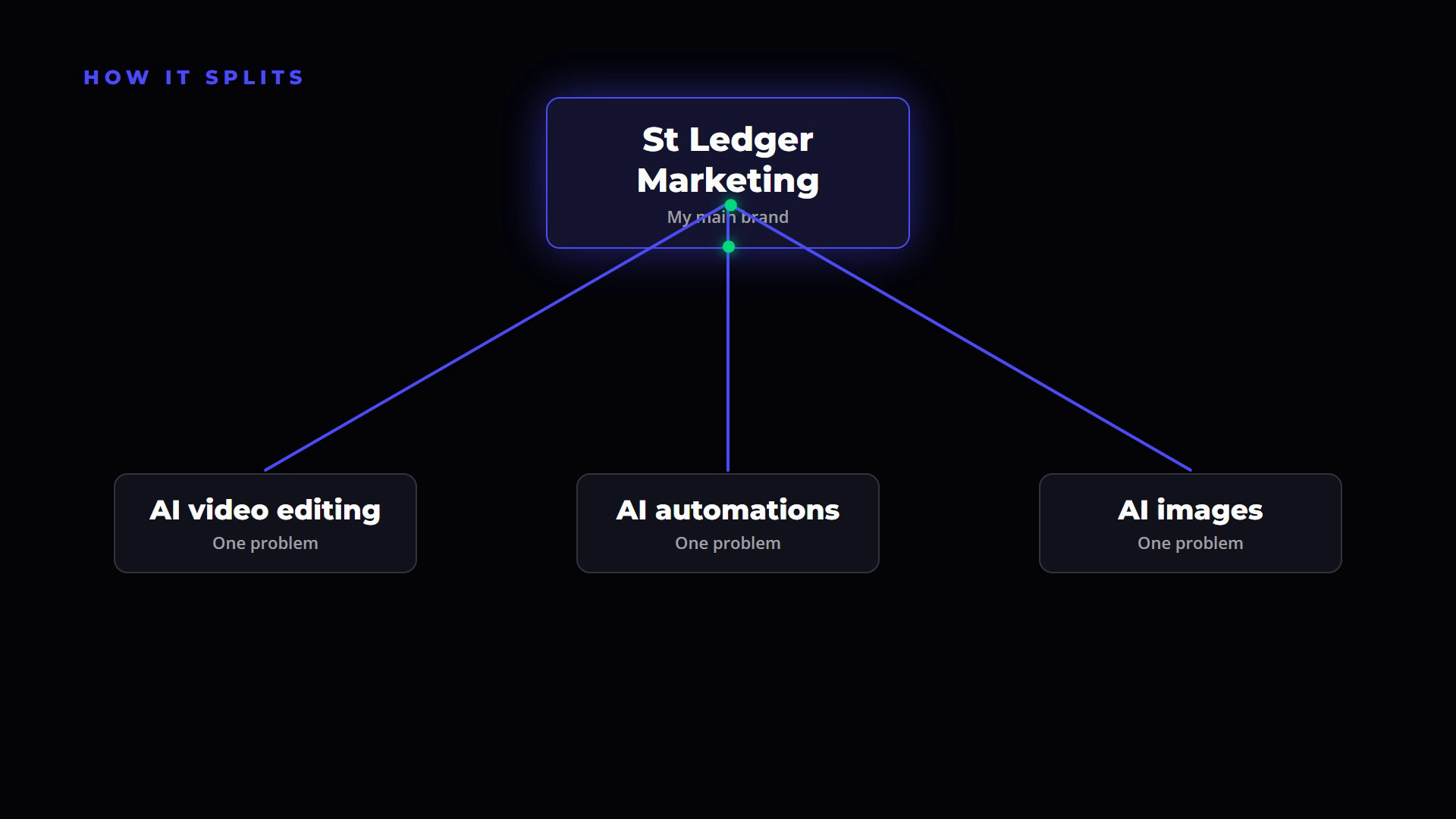
So the split goes the other way. The main account stays exactly as broad as it is, and the narrow promises move out into accounts of their own.
How to create a faceless Instagram account, step by step
Step 1: Pick one problem, not one topic
This is the difference between an account that works and an account that drifts.
A topic is "AI video editing". A problem is "my video editing takes four hours and I want it to take forty minutes". The topic describes a category. The problem describes somebody's Tuesday afternoon.
Write down the single problem the account exists to solve, in the words the person would use. Every post from then on answers that one thing. If a post idea does not answer it, it belongs on a different account or nowhere.
My three are:
- AI video editing, for people whose editing eats their week
- AI automations, for people doing the same task by hand every day
- AI images, for people who need visuals and cannot design
Three problems, three accounts. Not three topics.
Step 2: Decide what the account will never post
This step takes five minutes and saves you months.
Write the list of things that are adjacent, interesting, and banned. On the AI video editing account that list includes lead magnets, email marketing, and my own business updates. All three are things I know about. None of them is why anybody followed that page.
The discipline is the product. An account that only ever answers one question is worth following precisely because you know what you are going to get.
Step 3: Choose your faceless format
You need a format you can produce repeatedly without dreading it. There are three that work without a camera:
Reels with on-screen text and a voice over. The workhorse. You can make them from a screen recording, from stock footage, or from generated visuals. Every reel answers one problem and ends on the solution.
Carousels. Slower to make, but they get saved, and saves are worth more than likes for a page trying to establish that it knows things. Use them when the answer genuinely needs several steps.
Single images. For one hard point that does not need a build. Cheap to produce, good for keeping a page alive between bigger pieces.
I am not scheduling these by type. Carousels and images get made when the post is genuinely better as one, and reels carry the rest.
Step 4: Set up the voice
This is where most faceless accounts go wrong, and it is worth being specific.
The obvious move is an AI avatar: a generated person who delivers the script. I have tested them and I am not using one. They still read as artificial, and an account whose entire premise is trust cannot afford a presenter that makes people squint.
What I am doing instead is cloning my own voice and putting it over the visuals. No face, but a real person's voice, saying things a real person wrote. Tools like ElevenLabs and Higgsfield both do this.
That distinction matters legally as well as aesthetically. Under the EU AI Act, AI-generated or AI-manipulated audio and video has to be disclosed. A cloned voice is AI-manipulated audio. So every one of these accounts carries the platform AI label and says so in the caption.
I would do that anyway. The accounts are openly AI-assisted, and pretending otherwise would be the one thing that actually breaks them.
Step 5: Connect every account to one offer
Here is the structural point that makes multiple accounts worth running at all.
You split the audience. You do not split the offer.
Three accounts, three different problems, three different groups of people arriving. All of them end up in the same place, because the place solves all three problems. Splitting the destination as well would just give you three small things instead of one that works.
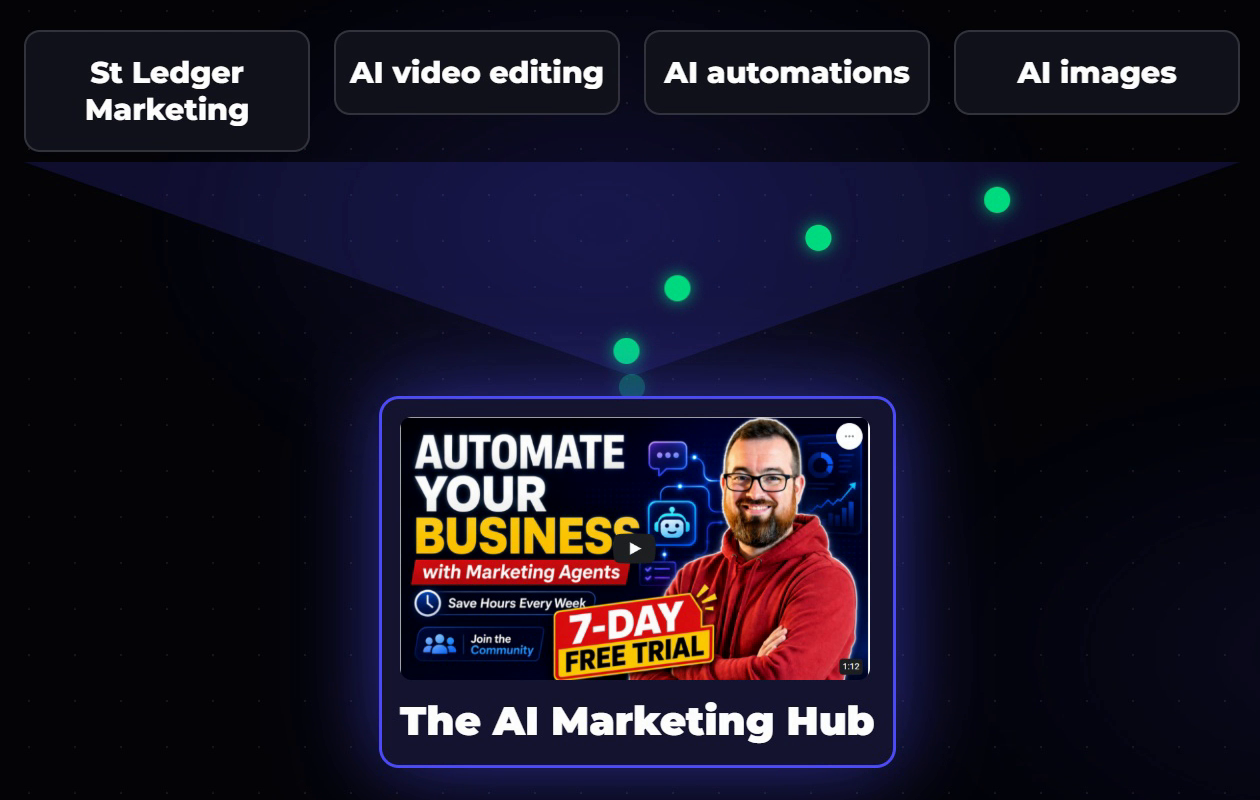
Practically, that means every account's bio points at the same destination, and every call to action asks for the same thing.
The mechanism I am using for this is a keyword automation. Someone comments a word on a post, and they get sent the link automatically. It works because it is a low-effort action that happens inside the app, and it works across every account at once without me being awake.
Step 6: Warm the account up by hand
Nothing about a brand new account is automatic, and anyone who tells you otherwise has not started one recently.
A new Instagram account with no history gets very little distribution. Posting into that with an automated queue from day one is a good way to look like a bot to a platform that is actively looking for bots.
So the first week or two is manual. Post by hand, respond by hand, be visibly a person using the app. Once the account has some history and some signal, the scheduled content goes on top of that. Not before.
The model this copies
None of this is a new idea. It is what large creators have been doing for years, and you can go and look at it.
Gary Vaynerchuk's main channel is the front door. Behind it sit GaryVee Video Experience, GaryVee Clips, GaryVee Vlogs, Curse Free GaryVee, and GaryVee Español. Alex Hormozi runs the same shape with MoreMozi alongside his main channel.
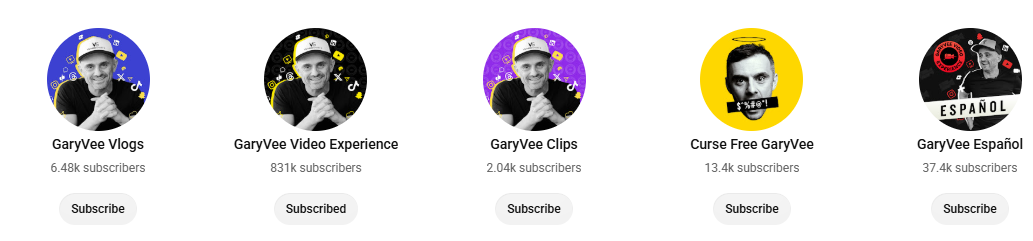
Look closely at that spread, because it is the honest part. Of the five, one has hundreds of thousands of subscribers and the rest sit between two thousand and forty thousand. The model works, but it does not work evenly, and anybody showing you this strategy with all five numbers blurred out is selling you something.
What each one does share is a job. Clips exists to cut long content into short. Español exists to serve a language. Curse Free exists to be safe for a context the main channel is not. Every one is a different door into the same building.
What this actually costs in time
The reason this is possible at all is that the content pipeline already exists. I produce around a hundred posts a week across my current channels. Three more accounts is not three times the work, because the work is in deciding and producing, and both of those already happen.
The scheduling side is genuinely cheap. I use Blotato as the single connection point, which carries twenty social accounts on the plan I am already paying for. I am using six. Going to ten still sits inside what I have.
My hard limit is that this cannot cost me another two or three hours a day. If it does, it has failed on its own terms, no matter what the follower counts say.
Where this can go wrong
A day-one article that does not list the failure modes is a sales page. So:
A new account has no distribution. The first few weeks are posting into an empty room. It will look like failure and mostly it is just arithmetic.
A call to action on a page with forty followers converts nobody. The funnel described above does not exist yet. It is a shape waiting for an audience.
Three accounts is three times the posting. If the pipeline stalls, three accounts die instead of one.
Faceless content has no face to trust. It has to earn attention on the work alone, which is a harder job and a slower one.
And it might simply not work. I have no results. That is the entire premise of writing this now rather than in six months, when I would be able to choose which numbers to show you.
Frequently asked questions
Do you need a face to grow on Instagram?
No. Faceless accounts grow on the strength of the promise instead of the personality. The trade is that the topic has to be narrow and the content has to be consistently useful, because there is no familiarity doing the work for you.
How many Instagram accounts can one business run?
As many as it can feed. The real limit is content supply, not the platform. If you cannot comfortably fill one account, a second one will halve the quality of both rather than double the reach.
Should each account have its own offer?
No. Split the audience, keep one offer. Separate accounts exist so that each audience hears their own problem named. They should all arrive at the same destination, because a single strong offer beats three weak ones.
Is AI-generated Instagram content allowed?
Yes, and it has to be labelled. Use the platform's own AI label and say so in the caption. Under the EU AI Act, AI-generated or manipulated audio and video carries a disclosure requirement, and a cloned voice counts.
What happens next
Everything above is a plan. The follower counts are zero, the automations are built but untested at any volume, and the content pipeline that makes this affordable has never had to feed four accounts at once.
That is the useful version of this article. Come back and check it.
Disclosure: Some links in this article are referral links. If you use one, I may earn a commission at no extra cost to you. I only link to tools I actually use.
How this was made: The facts, numbers and examples in this article come from my own work and videos. I use AI to help draft and structure the writing, then I review and edit every line myself before it goes live.

About the author
I'm Wayne St Ledger, and I run St Ledger Marketing. I started out in construction as a plasterer, then went on to a Bachelor's in Marketing and a Master's in International Business, which is where my bias toward results over talk comes from. I help business owners build marketing systems they actually understand, using AI in grounded, practical ways rather than hype. I also run a YouTube channel on marketing and AI, and The AI Marketing Hub, my own community for business owners and marketers putting AI to work properly.