Most small business owners ask how much a social media manager costs at exactly the wrong moment. It is usually after a month of posting in bursts, missing a week, and feeling guilty about it. At that point any number sounds reasonable, because the alternative is doing it yourself on top of everything else.
So it is worth pulling the job apart before you price it. A social media manager does several different things, and one of them, getting posts out on time to every platform, turns out to be the part that eats the most hours and the part that is easiest to hand to software. Last month I published 304 posts. I did the maths on what that one part of the job would have cost me to pay someone for, and it came to about $1,600. What I actually paid was $29.
What a social media manager costs in 2026
Start with the published numbers, because they settle the question faster than any opinion.
In the United States, Indeed puts the average social media manager at $65,623 a year, from 3,200 job postings, with a typical range of $41,173 to $104,593. One level down, the average social media specialist earns $21.13 an hour.
In Ireland the figures are lower. Indeed Ireland lists the average social media manager at €38,974 a year, and a social media specialist at €32,014, which works out at roughly €15 to €16 an hour on a 39-hour week.
Those are salaries for a full-time hire. Most small businesses are not hiring full time, so the more useful question is narrower: what does each part of the job cost, and which parts do you actually need a person for?
What the scheduling part alone costs
Here is the part I measured. Scheduling means taking finished content and getting it out: the right caption, on the right platform, at the right time, every day.
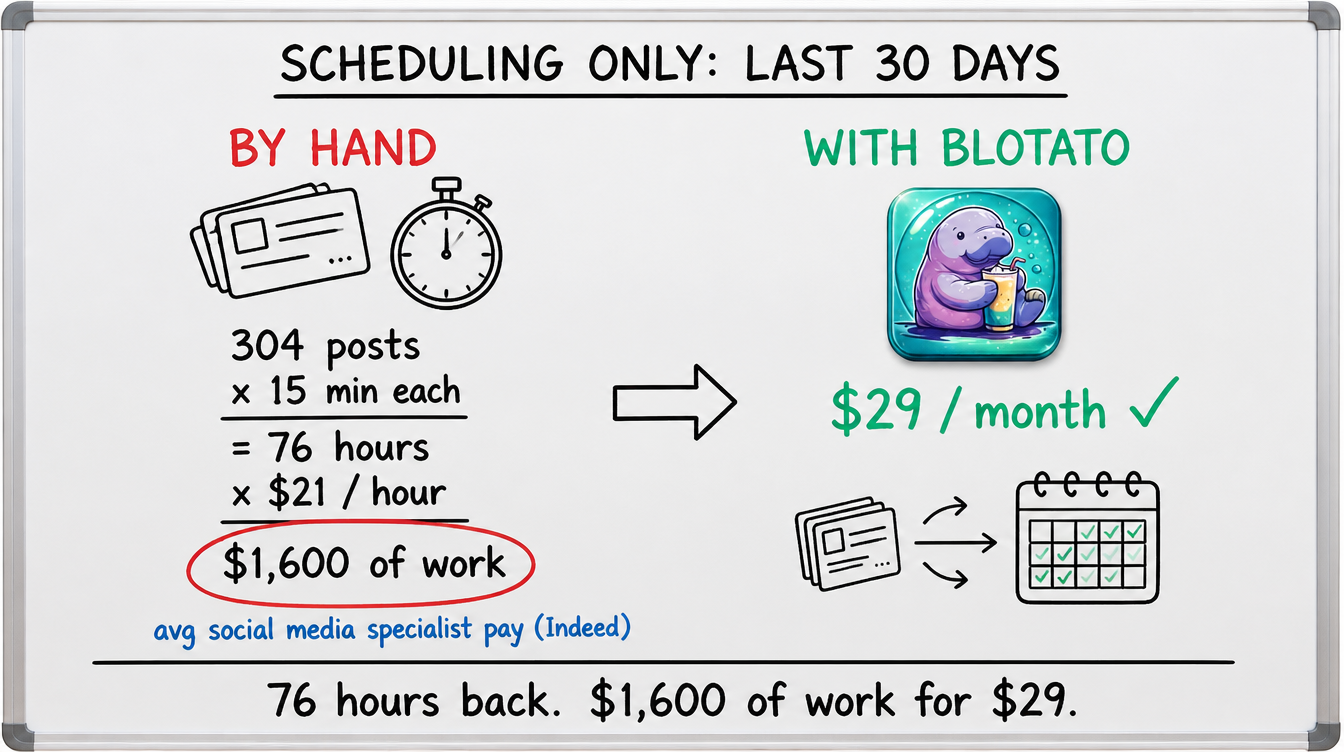
The sum is simple:
- 304 posts went out in the last 30 days, across Instagram, LinkedIn, Facebook, YouTube, TikTok and X.
- 15 minutes a post is the estimate for doing that by hand: open the platform, upload, paste the caption, pick the time, check it went.
- 76 hours is what that adds up to.
- At $21 an hour, that is about $1,600 of work in a single month.
Two honest caveats. The 15 minutes is the estimate my scheduling tool uses, not something I timed with a stopwatch. And the $21 is an average, so a junior assistant in Ireland on €15 an hour brings the figure down to around €1,140. Either way the order of magnitude does not change. Getting posts out is a four-figure job every month when it is done by a person.
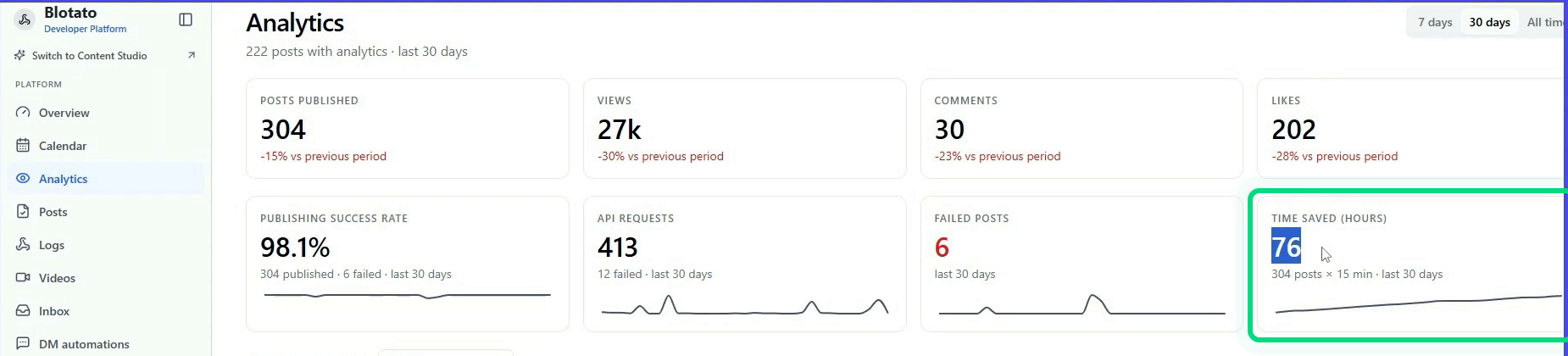
The same page showed six failed posts. Those were my fault, not the tool's. I had not reconnected a Facebook account, and nothing publishes to an account that has lost its connection. It is worth checking your connections every so often for exactly that reason.
What a tool costs instead
The tool doing that scheduling is Blotato. Its Starter plan is $29 a month and covers up to 20 social accounts, so the price does not climb as you add platforms or even a second brand.
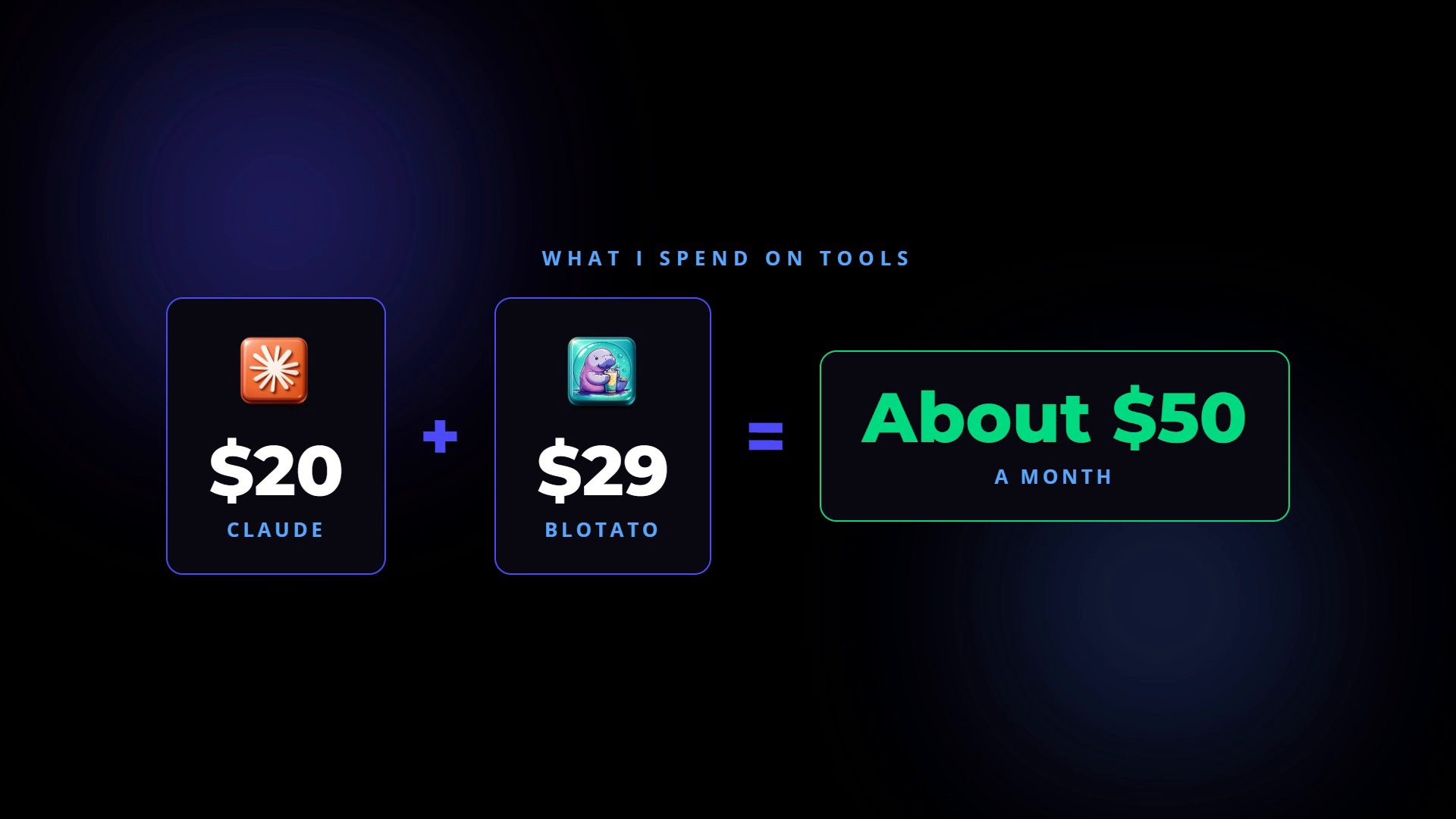
I run it through Claude, which writes and organises the content and hands it to Blotato to publish. Claude Pro is $20 a month. So the stack that replaced roughly $1,600 of scheduling work costs about $50 a month in total.
The new version of Blotato has also made the job easier to keep an eye on. The overview page shows the whole week at a glance, how many posts go out each day and to which platforms, and the calendar view, which used to be the hard one to read, now shows every post and platform clearly.
What a manager does that a tool does not
This is where the honest answer to "how much does a social media manager cost" gets more interesting. Scheduling is the biggest block of hours, but it is not the most valuable part of the job.
A good social media manager also decides what to post and why, writes in a voice that sounds like your business, replies to people, spots what is working, and tells you when something is not. A scheduling tool does none of that judgement. AI helps with a lot of the writing, but somebody still has to decide what the business is trying to say.
So the realistic options for a small business look like this:
| Option | Rough monthly cost | What you still do yourself |
|---|---|---|
| Full-time social media manager | $5,000+ (US average salary) | Very little |
| Part-time assistant doing the posting | $1,000 to $1,600 | Strategy, content, replies |
| AI plus a scheduling tool | About $50 | Strategy and a short recording session |
The middle row is the one most small businesses end up paying for without realising it, often in their own time rather than in cash. That is the row a tool replaces.
Using the same budget for a second account
Once the posting costs almost nothing, the question changes. It stops being "can I afford to be consistent on one account" and becomes "what else could this budget run".
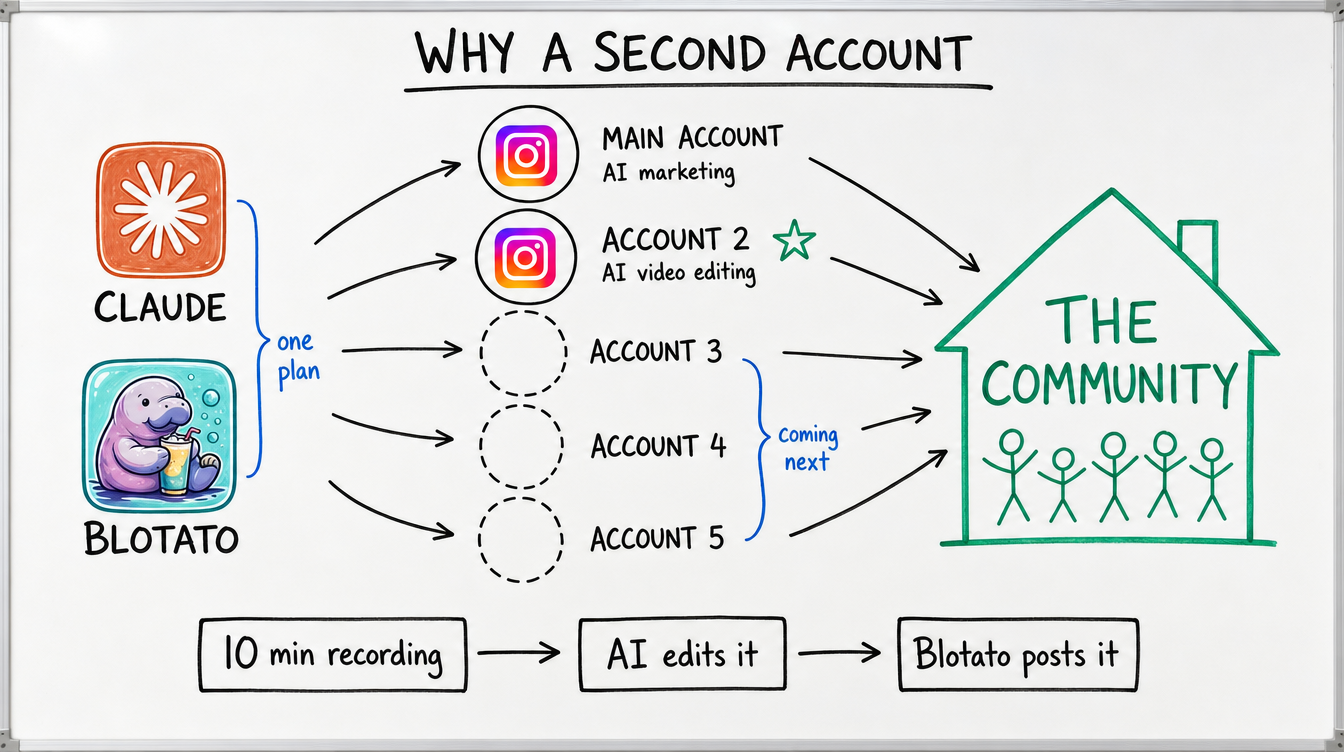
My answer was a second Instagram account focused only on AI video editing. The main account covers a bit of everything in AI marketing. The idea is to test whether narrower accounts, each on one specific problem, grow faster, with every account pointing back to the same community. The workload is small: I record on my phone for about 10 to 15 minutes, AI edits the reels, and Blotato posts them. The DM automations I had already built on the main account were simply duplicated onto the new one.
It is day one for that account, so there are no results to report yet. What I can say is that it added nothing to the monthly bill.
Frequently asked questions
How much does a social media manager cost per month? A full-time social media manager in the US averages $65,623 a year according to Indeed, which is about $5,500 a month before employer costs. In Ireland the average is €38,974 a year. Part-time help or a specialist is typically charged by the hour, at around $21 an hour in the US.
How much does it cost to have someone schedule social media posts? At roughly 15 minutes a post and $21 an hour, scheduling costs about $5 a post. For a business publishing around 300 posts a month across several platforms, that is roughly $1,600 a month for the posting alone.
Is a scheduling tool cheaper than a social media manager? For the posting part, yes, by a wide margin. A tool like Blotato costs $29 a month for up to 20 accounts. It does not replace the strategy, writing or community side of the job, which still needs a person.
Can one tool manage multiple Instagram accounts? Yes. Blotato's Starter plan covers up to 20 connected social accounts, including more than one Instagram account. Each account has to be an Instagram Business or Creator account linked to a Facebook Page, which is Meta's rule for publishing through a tool.
What does a social media manager do that AI cannot? Judgement. Deciding what the business should say, spotting what is working, handling replies and knowing when something is off-brand. AI speeds up the writing and a scheduler removes the posting, but the decisions are still yours or your manager's.
Where to start
The quickest win is to look at your own month. Count the posts, multiply by 15 minutes, and put a real hourly rate on it. For most small businesses that number is larger than they expect, and it is almost all the part of the job that software now does for the price of a lunch.
If you want to see how I set up the content side, from recording to AI editing to scheduling, it is all inside The AI Marketing Hub. There is a 7 day free trial to look around before you commit to anything.
Disclosure: Some links in this article are referral links. If you use one, I may earn a commission at no extra cost to you. I only link to tools I actually use.
How this was made: The facts, numbers and examples in this article come from my own work and videos. I use AI to help draft and structure the writing, then I review and edit every line myself before it goes live.

About the author
I'm Wayne St Ledger, and I run St Ledger Marketing. I started out in construction as a plasterer, then went on to a Bachelor's in Marketing and a Master's in International Business, which is where my bias toward results over talk comes from. I help business owners build marketing systems they actually understand, using AI in grounded, practical ways rather than hype. I also run a YouTube channel on marketing and AI, and The AI Marketing Hub, my own community for business owners and marketers putting AI to work properly.