Gary Vee says post 300 times a day. The comment under every one of those videos says some version of the same thing: normal people cannot keep up with this.
Both are right, and that is the problem. He has a full team, a full budget and a camera following him around. You have a business to run, and the content sits on top of that. Nobody is hiring a content team to sell plumbing services or run a salon.
I sit somewhere in the middle, on my own, and that middle is the part nobody talks about. So this is the honest answer to how often to post on social media, with the survey data on what owners genuinely manage, and my own real weekly numbers rather than an aspirational figure.
What Small Business Owners Actually Post
Start with the real picture rather than the version people admit to online.
Adobe Express surveyed 433 business owners about how often they post. The results are not close to the advice being shouted at them.

Forty four percent post once a week. Eighteen percent post daily. Twenty one percent post once a month, and another eighteen percent post less often than that, according to the Adobe Express small business survey.
Read the top line again, because it is routinely misquoted. The most common schedule is once a week. That works out at roughly four to five posts a month. Not four to five a week. It would be misleading to say the average owner posts daily when fewer than one in five of them do.
The same survey found sixty three percent of owners feel pressure to post daily. So the gap is not just a scheduling problem. Most owners are posting monthly while feeling they should be posting every day, which is the fastest route to giving up on it entirely.
Why "Post 300 Times a Day" Lands On The Wrong People
The advice is not wrong. It is aimed wrong.
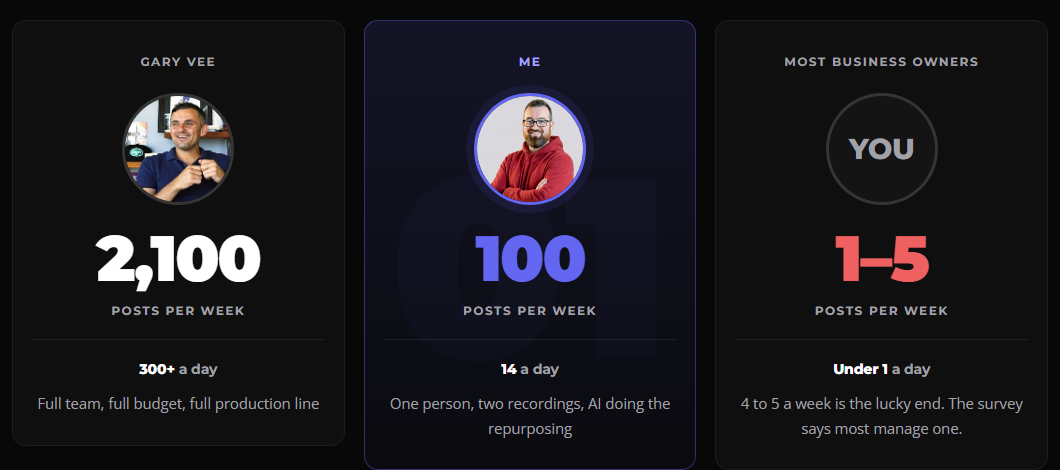
Roughly 2,100 posts a week go out from his brand. That is 300 plus a day, across every platform, in every format, with sub-handles feeding the main one. Full team, full budget, full production line.
I post about 100 times a week. I am well off him, about 2,000 posts off it, and I am not pretending otherwise. But I am a long way ahead of most business owners sitting at one to five a week.
Between five a week and 300 a day, there is no bridge on offer. That missing middle is the reason the comment section is angry. Everyone is arguing about the two ends and nobody is describing the road between them.
So How Often Should You Actually Post?
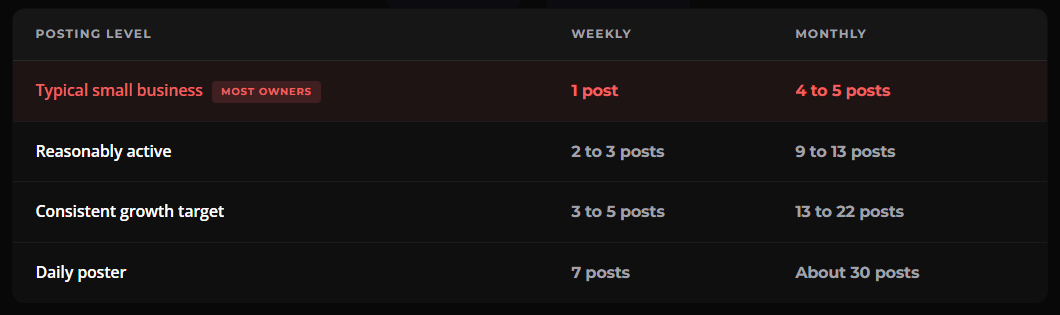
Here is the ladder, from where most owners actually are to where a daily poster sits.
The tool companies themselves land in roughly the same place. Adobe's own guidance on posting frequency puts the sustainable target for a small business at around two to five quality posts a week, depending on the platform.
So the honest answer to how often to post on social media is this: three to five posts a week is the target worth aiming at, not seven a day and not once a month. That is thirteen to twenty two pieces a month, and it is achievable without a team.
If you are currently at one a week, do not try to jump to daily. Going from zero to three a day is not the move. Going from one a week to three a week is, and it is a change you will still be making in six months.
Volume Is Not About The Algorithm
This is the part that gets missed, and it is the reason the advice to post more is still right even when the number attached to it is silly.
The volume is not about pleasing an algorithm. It is about how fast you find out what people actually want from you.
When you post once a day, you get seven data points a week. That is not enough to tell you anything. You are guessing, so you keep repeating whatever felt right, and you find out whether it worked some time next quarter.
At a hundred a week the patterns show up in days instead of months. You can see which topic and which format people genuinely save and share, and you know exactly what to make more of next week. The first batch will be rough, and it should be. The point is to get enough out there to find the two or three angles that land, then double down on those.
That is the actual argument for volume. Not reach. Feedback speed.
How Two Recordings Become 100 Posts a Week
The number only works because almost nothing in it is made from scratch.

The first input is one long-form video, which I record anyway. My recording window is roughly nine to half eleven in the morning, and I try to hit it most days. That single recording becomes about fifteen pieces: four or five shorts cut from it, three carousels, two infographics, three b-roll clips and image posts, one SEO article, and a text post.
The second input is my phone. I set it up beside the camera and record fifteen or twenty minutes of me talking through a topic, with no lighting, no set and no plan. That gets chopped into shorts and posts the same way, for another fifteen pieces.
Two recordings, roughly thirty unique pieces. Then each piece goes out on more than one platform, because if you post something to Instagram there is no reason not to send it to TikTok, Facebook and LinkedIn as well. Not everyone on one is on the other. That multiplies thirty into roughly a hundred, which is about fourteen a day.
None of that requires a team. It requires the repurposing step to be automated, and it requires you to be honest that the recording is the only real work in the chain.
If you want the practical version of that step, the content repurposing system covers how one video gets broken into its pieces, and the best way to repurpose content covers the workflow itself.
The Honest Catch
Volume is the easy part now. That is genuinely new, and it is why the old "quality over quantity" argument no longer settles anything.
What has not changed is the input. If you put bad information in, you get thirty bad pieces of content out. AI multiplies whatever you give it. If what you recorded was weak, you now have thirty weak posts instead of one, published faster and to more places.
So the fifteen minutes you actually speak still matter more than anything downstream of them. The tools removed the labour, not the thinking.
That is also why I would not chase a hundred a week from a standing start. Get the recording right, get one repurposing step automated, and let the number climb from three a week to ten to thirty. The ceiling moves on its own once the input is solid.
Frequently Asked Questions
How often should a small business post on social media?
Three to five quality posts a week is the realistic target for most small businesses, which works out at thirteen to twenty two a month. Most owners currently manage about one a week, and the platforms themselves recommend two to five.
Is it better to post once a day or five great posts a week?
Five strong posts beat seven weak ones, but the trap is that you cannot tell which of yours are strong until you have posted enough to see the pattern. Post at a volume that gives you feedback, then let the data tell you what to make more of.
How many times a day does Gary Vee post?
Around 300 a day, roughly 2,100 a week across his brand's accounts. That is produced by a full team with a budget, so it is not a benchmark for a business owner working on their own.
Can one person really post 100 times a week?
Yes, but not by creating a hundred things. It comes from two recordings a day being repurposed into about thirty unique pieces, then each piece being posted to several platforms.
What happens if I post too often?
The risk is not frequency, it is repetition and thin content. If the volume comes from one solid recording being repurposed properly, more posting gives you faster feedback. If it comes from generating filler, more posting just spreads the filler further.
Disclosure: Some links in this article are referral links. If you use one, I may earn a commission at no extra cost to you. I only link to tools I actually use.

About the author
I'm Wayne St Ledger, and I run St Ledger Marketing. I started out in construction as a plasterer, then went on to a Bachelor's in Marketing and a Master's in International Business, which is where my bias toward results over talk comes from. I help business owners build marketing systems they actually understand, using AI in grounded, practical ways rather than hype. I also run a YouTube channel on marketing and AI, and The AI Marketing Hub, my own community for business owners and marketers putting AI to work properly.