Most advice on how to market digital products starts with “build an audience first”. Post every day for six months, grow a following, then launch. I wanted to know if there was a faster way to find out whether anyone would actually pay.
So I ran a small test. I took two AI video editing tools I already use every week, packaged them up as a one-off digital product at €129, had Claude build the landing page, and put €70 behind some Facebook ads. Over six to eight days, one person bought it.
This is everything I did, the real numbers, and the places it can still fall apart.
The three things you need to market a digital product
Strip it back and selling anything online comes down to three parts. Miss one and nothing happens.
- Traffic. People have to see the offer. That is either organic (your posts, your followers) or paid (ads).
- A landing page. Somewhere that explains what the product does, shows proof, and takes the money.
- A product. Something a stranger will hand over money for.
I already had the product, so my test was really about the other two. Could a landing page I did not code myself, plus a small Facebook ads budget, turn strangers into a sale?
Step 1: Sell something you already have
I did not want to build something brand new for this. Building a product from scratch can take months, and you only find out at the end whether anyone wants it.
Instead I took two skills I had built for Claude Code to edit my own videos. One edits short-form vertical videos for Reels, TikTok and Shorts. The other edits full-length YouTube videos. Both are already inside my AI Marketing Hub for members, and I use them every week, so the product was finished and tested before the first ad ran.
Two choices made the offer simpler to sell:
- It solves one problem. Video editing takes hours. The product takes that job off you. One clear problem is far easier to write an ad for than a bundle of loosely related things.
- It is a one-off payment. €129, paid once, yours to keep. No subscription and no monthly fee. For a stranger who has never heard of you, a single payment is a much smaller decision than signing up to something recurring.
If you are wondering how to market digital products without a big launch, start here. Look at what you already make, use or teach, and ask whether a stranger would pay for a packaged version of it.
Step 2: Let AI build the landing page
I cannot code and I have no interest in learning, so the landing page was built 100% with Claude.
I told it three things: what I was selling (two AI video editing skills), who it was for (people struggling to keep on top of content, and people who need help with editing), and the overall design I liked. It built out the whole page from that.
The first version was okay, not great. I went looking for inspiration on other accounts and platforms, fed that back in, and after a bit of back and forth I had a page I was happy with. The buy button is a Stripe payment link, so there is no website builder and no monthly plugin behind it.
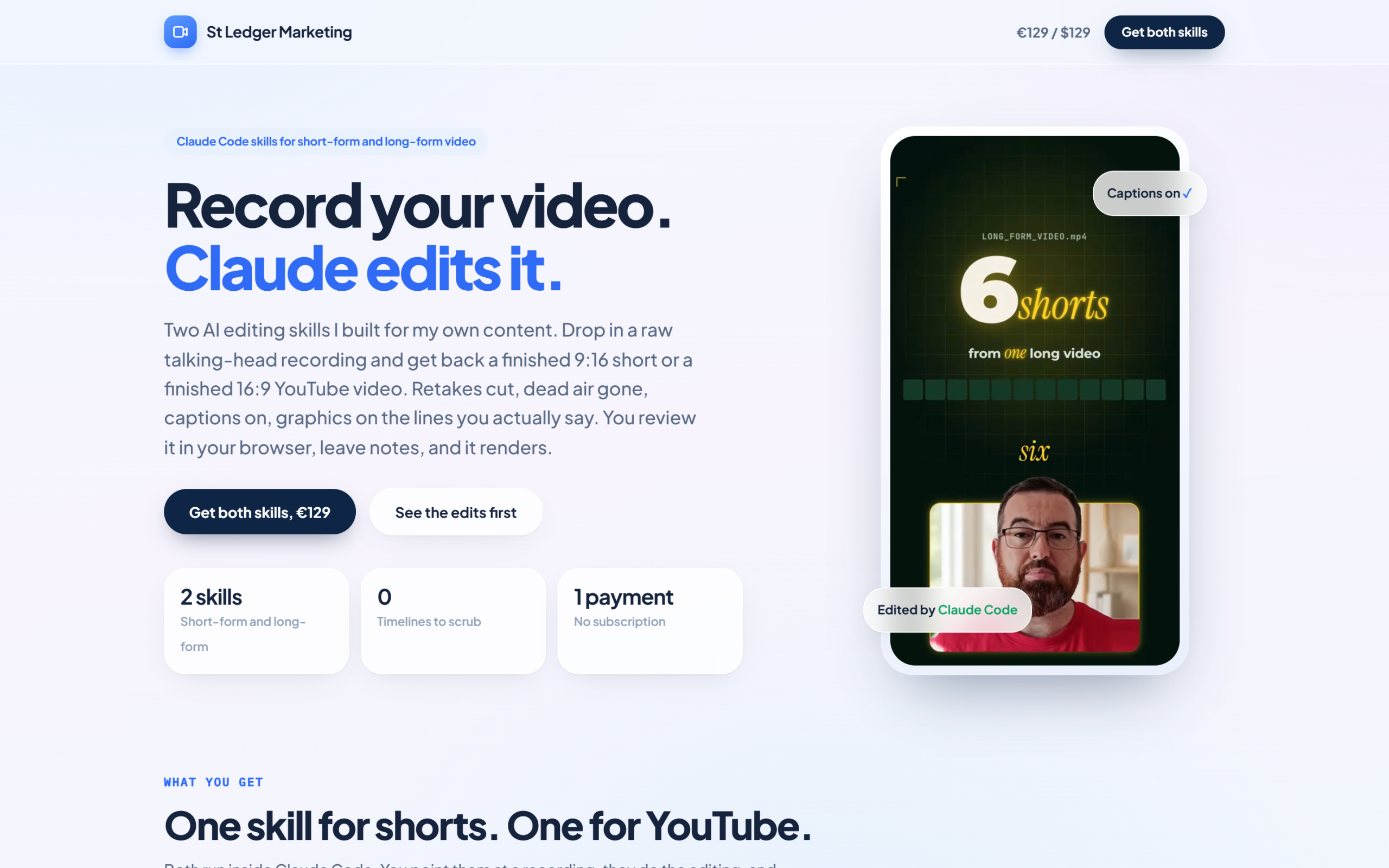
The layout follows one simple order: headline, proof, how it works, price. Every extra section is somewhere for someone to leave.
- Headline: what the product does, in a few words.
- Proof: real shorts and real YouTube videos the skills edited, not mock-ups.
- How it works: four steps, from paying to rendering your first edit.
- Price: one figure, one button.
The two mistakes I would fix first
Looking back at the page with fresh eyes, two things stand out.
My long-form examples sent people away. I linked them out to YouTube, so a click opened a different site instead of playing on the page. You do all the hard work of getting someone onto your landing page, so you want them to stay there. Those videos should play in place.
The offer could sound like a better deal. “Both skills for €129” is fine. “Buy one skill, get the second one free”, maybe at €99, sounds like a bargain, even though the buyer gets exactly the same thing.
Step 3: Use Facebook ads to buy the traffic
This is the part that makes the test fast. Organic traffic works well if you already have a decent following. If you are starting from nothing, it can take months before enough people see your offer to tell you anything.
My new Instagram account focused on AI video editing had two followers when I ran this. Waiting for organic reach there would have told me nothing for a long time. Facebook ads cut that wait out.
I used videos from both of my Instagram accounts as the ads, my main business account and the new editing account, to see which one worked better. Some ads did well. Some were rubbish.
The results, after six to eight days:
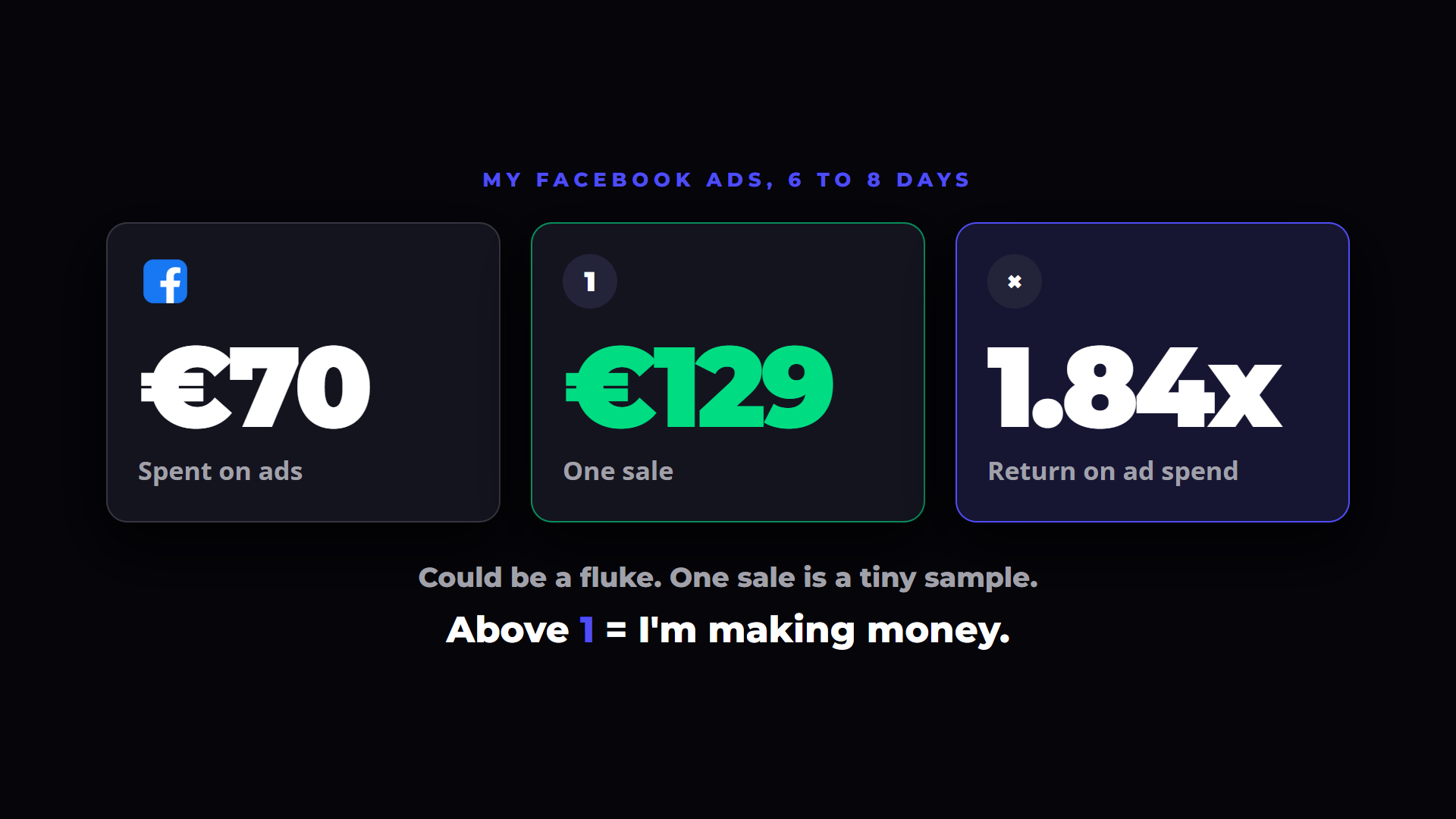
- Spent on ads: roughly €70
- Sales: 1, at €129
- Return on ad spend: 1.84x
Return on ad spend (ROAS) is simply what came back divided by what went in: €129 divided by €70. Anything above 1 means the ads brought back more than they cost. Below 1, you are paying more for each sale than the sale is worth.
Step 4: Do the honest maths
€129 sounds good. Here is what is actually left.
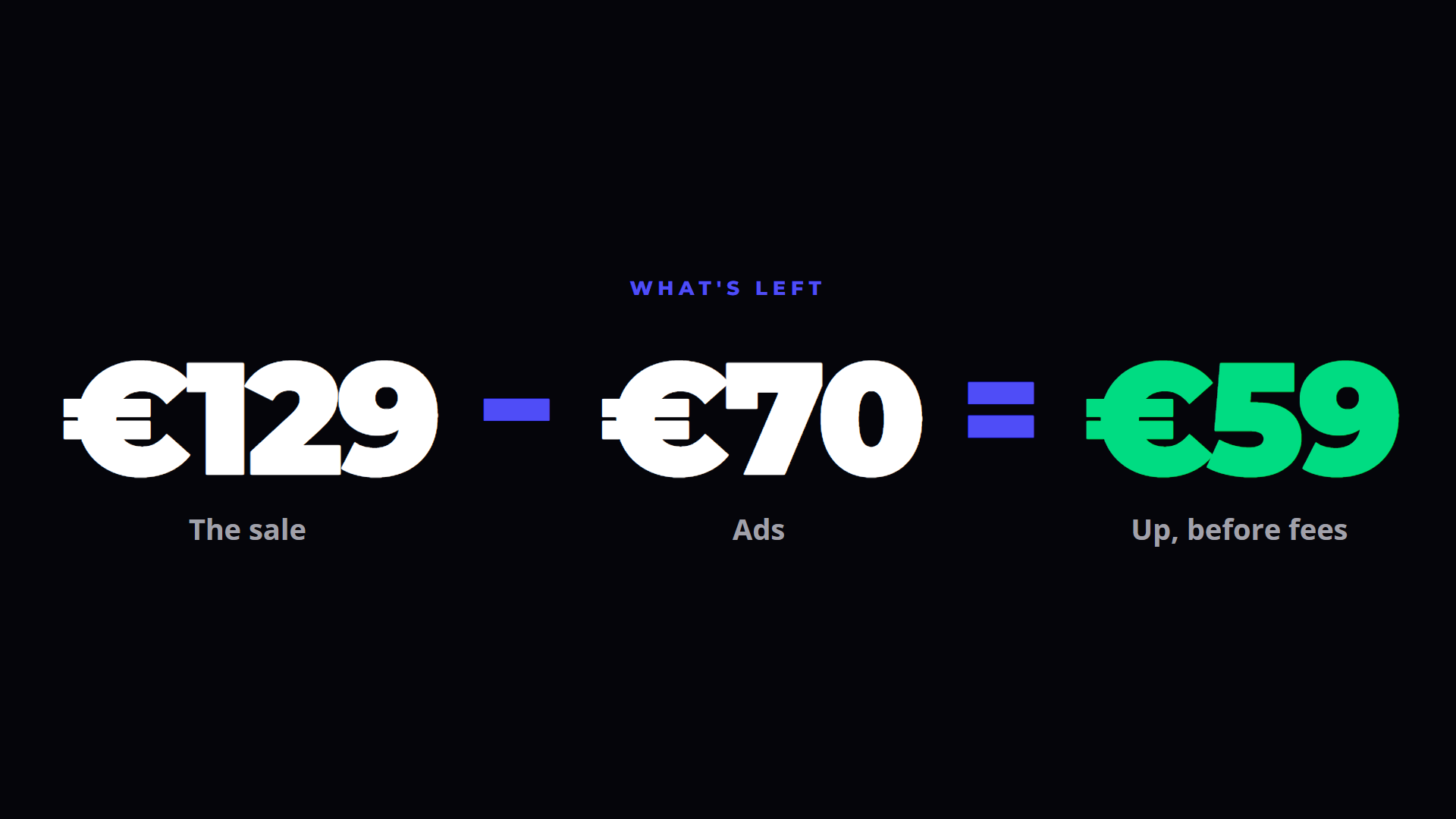
Take off the €70 of ads and I am €59 up. That is before fees. Stripe charges 1.5% + €0.25 on standard European cards, according to its Irish pricing page, which is about €2.19 on a €129 payment. VAT comes off after that.
So the test proved one thing: people will pay for this. It did not prove it is a business yet.
Where marketing a digital product breaks
Every stage of this can go wrong, and it is worth knowing where before you spend anything.
- The offer. The product might not be good enough, or people might not manage to install or set it up.
- The landing page. It might simply not convert. You need tracking, like the Facebook pixel, to see where people drop off.
- The ads. Some creatives are just bad. I have run ads that were absolutely useless and did nothing for me.
- The sample size. One sale is a tiny sample. This could have been a fluke.
That last one matters most. My ads are still running. If no second sale comes in, the ROAS drops from 1.84 to 1.6, then 1.4, and if it falls below 1, the ads are losing money and there is no point running them.
When that happens, do not change everything at once. Change one thing, test it, then change the next:
- The creative. A new video or a new opening line.
- The landing page copy. Too much information, or not enough?
- The offer. The two-for-one idea, for example.
Is it worth it?
For me, yes. I was not sure anyone would pay for this at all, and someone did. That one sale gave me real information to work with, instead of sitting there wondering whether anyone would buy my product.
If you have a digital product, or an idea for one, this is the order I would follow:
- Have an idea? Build it. Keep it small enough to finish quickly.
- No idea yet? Look at what is already out there. Something you already use or know well is often enough.
- Run a small ad test before you build an audience. Find out if the idea is any good first.
What I would not do is spend months building a following on Instagram, posting every single day, before you know whether the product sells. If it turns out the idea is no good, those months are gone. A small ad test tells you in a week.
Frequently asked questions
How do you market a digital product with no audience? Use paid traffic to test it. A small Facebook ads budget puts the offer in front of strangers straight away, so you find out whether it sells without waiting months to grow a following.
How much should I spend on Facebook ads to test a digital product? Spend only what you can afford to lose if nothing sells. My test was roughly €70 over six to eight days, which was enough to get one sale and a first read on the offer.
What is a good ROAS for a digital product? Anything above 1 means the ads earned back more than they cost. Mine came in at 1.84x on one sale, but one sale is a tiny sample, so treat early figures as a signal, not a result.
Do I need to code to build a landing page for a digital product? No. I built mine with Claude without writing any code, then added a Stripe payment link to the buy button.
What should a digital product landing page include? A clear headline, real proof, a short “how it works” section and one price with one button. Every extra section is another place for a visitor to leave.
Where to start
Pick one thing you already make or use, package it as a single one-off product, build a simple page for it, and put a small budget behind it for a week. Whatever the result, you will know more than you would from another month of guessing.
If you want the two video editing skills from this test, plus the walkthroughs on setting them up, they are inside The AI Marketing Hub.
Disclosure: Some links in this article are referral links. If you use one, I may earn a commission at no extra cost to you. I only link to tools I actually use.
How this was made: The facts, numbers and examples in this article come from my own work and videos. I use AI to help draft and structure the writing, then I review and edit every line myself before it goes live.

About the author
I’m Wayne St Ledger, and I run St Ledger Marketing. I started out in construction as a plasterer, then went on to a Bachelor’s in Marketing and a Master’s in International Business, which is where my bias toward results over talk comes from. I help business owners build marketing systems they actually understand, using AI in grounded, practical ways rather than hype. I also run a YouTube channel on marketing and AI, and The AI Marketing Hub, my own community for business owners and marketers putting AI to work properly.