
AI Employee for Small Business: How One Runs My Whole Marketing
Hiring a marketing team is expensive. A single marketing manager in Ireland earns between €75,000 and €85,000 a year, according to the Morgan McKinley 2026 salary guide, and that is one seat. Add a content creator, a designer, a video editor, and someone to schedule it all, and a proper team runs well into six figures before a single post goes out. Most small business owners simply cannot justify that. So they do it all themselves, badly, in the gaps between actual work.
There is now a third option. An AI employee for small business is a single AI assistant you brief in plain English, that decides which part of your marketing should handle a request, does the work to a draft, and hands it back for your approval. Not a pile of disconnected tools you have to operate one by one. One point of contact that runs the whole operation. I built one, his name is Alex, and below is exactly how he works, what he costs, and where a human still has to stay in the chair.
What an AI employee for small business actually is
An AI employee for small business is one AI assistant set up to act like a chief of staff for your marketing. You make a request the way you would to a real team member, in normal language, and it works out which part of the business should handle it, does the task, and brings back finished work for you to sign off.
The difference between this and the usual AI experience matters. Most people open one chatbot for captions, another tool for images, a third for scheduling, and a fourth for research, then spend their day jumping between them. The AI employee sits a level above all of that. You talk to it, and it operates the tools on your behalf. In my own setup I run nine working departments behind a single assistant. I never open a department myself. I tell Alex what I want, and he routes it, enforces the same brand rules everywhere, and runs several departments in parallel from one request.
The key word is employee, not autopilot. This is built to mirror a business hierarchy on purpose, because that is where the control lives. You are still the founder. You set the direction, you give the go-ahead, and you confirm whether the output is good enough or needs another pass. The AI takes the heavy lifting off your plate. It does not take the decisions.
Why one AI employee beats a pile of clever tools
A pile of clever tools is not a team. That is the whole point. Five separate AI subscriptions can each do something impressive and still leave you as the exhausted middle manager copying output from one into another, fixing the brand voice every time, and chasing yourself for the next step.
An AI employee removes that coordination tax. One brief mobilises the entire operation. When I ask for content off the back of a video, it spins up research, packaging, repurposing, and articles in the background and gets everything to a point where I just confirm I am happy or send it back. There is no back and forth across tabs, no re-explaining the brand on every task, no constant context switching between one tool, one skill, one job at a time.
It also enforces consistency, which is where most solo marketing falls down. Because every department answers to the same assistant, the brand voice, the content pillars, and the calls to action are applied the same way across everything that goes out. That is genuinely hard to do by hand when you are the only person and you are tired. It is trivial when one layer sits over the top checking it every time. This is the part of ai marketing for small business that owners underestimate: the win is not any single clever output, it is the system that keeps all of them on-brand without you policing it.

How the AI employee runs each stage of the funnel
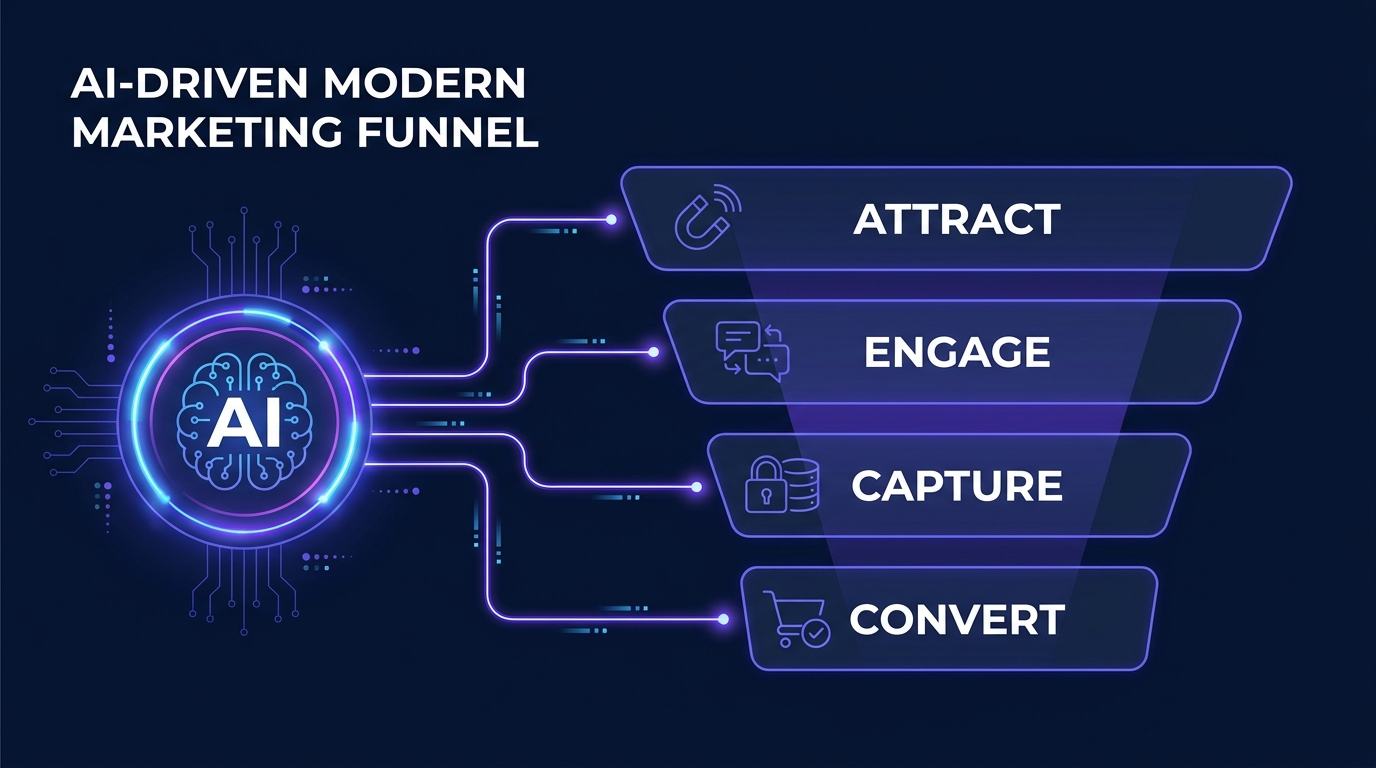
The reason this works is that it is built on a marketing funnel, not on letting AI run off and make things for the sake of it. Every department has a job, and the jobs map to a stage: attract, engage, capture, convert. Underneath all of it sits a foundation layer that informs everything else.
Foundation and research
Before anything gets made, the assistant decides what is worth making. It pulls live trends across more than ten sources, reads my own Google Search Console data, and checks it against my content pillars, then tells every other department what to produce next and why. This is the part that stops you wasting effort on content nobody wants. Since I started pointing the work with research instead of guessing, my videos went from 10 to 20 views to a few in the 150 to 160 range, and people actually joined the community off the back of them.
Attract
At the top of the funnel, the AI employee handles YouTube packaging and SEO articles. The packaging side takes a finished video and generates the description, chapters, tags, thumbnail concepts, and short teaser clips, scored against a tool like VidIQ so the title is keyword-led rather than a guess. The old way meant spending hours on thumbnails and metadata after every edit. Now that grind is gone. The same assistant repurposes each video into an SEO article aimed at search traffic, which is how a single piece of content starts compounding into a content repurposing system rather than a one-off.
Engage and capture
In the middle, one long-form recording is broken down into reels, carousels, images, posts, infographics, and B-roll, each cut to a different angle. Film once, and instead of throwing away most of the value, you get a full batch of content from a single transcript. This is also where lead magnets and landing pages live. The assistant turns a topic into an interactive lead magnet on its own URL and builds landing pages that get pushed to free hosting, so capture is handled without a separate developer.
Convert
At the bottom, branded presentations do the closing. Decks for sales calls and premium training are what turn a lead into revenue and keep a member subscribed by proving the value week after week. The asset both converts prospects and retains members, which is the part most content plans forget about entirely.
What an AI employee costs versus an actual team
Here is the maths that makes this worth doing. A real marketing team is a six-figure commitment once you stack the salaries, and even one marketing manager is the €75,000 to €85,000 a year quoted above. The AI employee that does a meaningful slice of that work runs on three tools: a Claude Pro plan at around €20 a month, a scheduling tool at roughly €20 to €30, and an image generator at a similar price. Call it about €78 a month in total.
I am not going to pretend one assistant replaces a half-million-euro department outright. Take that comparison with a pinch of salt. The honest claim is narrower and more useful: for the cost of a few subscriptions, one person can run the output that would otherwise need several hires, and produce more of it, faster. That is not a marginal saving. It is the difference between doing marketing and not doing it at all.
The time return backs this up beyond my own numbers. Managers using AI save more than twice the time individual staff do, at 7.2 hours a week against 3.4, according to Business.com’s 2026 small business AI outlook. For an owner who carries the marketing, recovering most of a working day every week is the real prize, and it is why the majority of small businesses across every US state are now embracing AI. If you want the wider stack behind this, I break it down in my guide to the AI tools I actually use for content.

Where you still have to stay in control
This does not run on full autopilot, and that is a choice, not a limitation. You can let it run unattended, but the problem with that is you get buried in output you never really decided on, and you lose the thread of what you are actually doing. I keep a hand on it deliberately.
You stay the source of the ideas. The assistant will challenge you, suggest angles, and bring options, but the direction is yours. You also stay the final gate. Nothing goes out until you have looked at it and approved it, which is exactly how you stop a flood of off-brand or just-not-right material reaching your audience. And you stay the one who tunes it. When something works, you lock it in so the system learns what good looks like for your business specifically, because retention and what lands will differ by industry.
There is a fair criticism that this produces a lot of AI-assisted content, and to an extent it does. The answer is the control layer. A human sets the brief, a human approves the output, and the tools handle the tedious production in between. Used that way, it is the same shift behind any sensible approach to marketing automation for small business: you remove the grind, not the judgement. Your competition will start doing this. There is little reason to hand them the head start.
How to build your own AI employee
You do not need the full nine-department version to start. The build is incremental, and the structure matters more than the number of parts. Here is the sequence I would follow.
- Start with one assistant as the front door. Pick one capable AI workspace and decide that everything goes through it. The point is a single point of contact, so resist spreading the work back across separate tools.
- Write down your foundation. Put your brand voice, your content pillars, and your calls to action into a document the assistant reads every time. This is what keeps every output consistent, and it is the single highest-leverage thing you can do.
- Add research before production. Have the assistant pull trends and check your own search data before it makes anything, so you are creating what people actually want, not what you assume.
- Build departments one funnel stage at a time. Add a capability for attract, then engage, then capture, then convert. Get each one producing good drafts before you add the next, rather than trying to stand up everything at once.
- Keep the approval gate. Wire it so nothing publishes without your sign-off. Review, approve, and when something performs, feed that back so the system improves.
Pro tip: name your assistant and treat it like a hire. It sounds soft, but giving it a role and a hierarchy changes how you brief it. You stop typing one-off prompts and start delegating like a manager, which is exactly the behaviour that makes the whole thing run like a team instead of a tool.
FAQ
What is an AI employee for a small business?
An AI employee for small business is a single AI assistant set up to act like a chief of staff for your marketing. You brief it in plain English, it works out which part of your marketing should handle the request, completes the task to a draft, and returns it for your approval. Instead of operating several separate AI tools yourself, you talk to one assistant who coordinates them all and applies your brand rules consistently across everything.
Can an AI employee really replace a marketing team?
Not entirely, and it is more honest to say it replaces the output of several roles rather than the people. One assistant can handle research, content production, repurposing, lead capture, and presentations to a draft standard, which is work that would otherwise need multiple hires. You still provide the ideas and approve everything before it goes out. The realistic claim is that one person can produce the volume of a small team, not that judgment and strategy disappear.
How much does an AI employee for a small business cost?
The setup I use runs on about €78 a month: a Claude Pro plan at around €20, a scheduling tool at roughly €20 to €30, and an image generator at a similar price. Compare that with a single marketing manager in Ireland at €75,000 to €85,000 a year, before you add a content creator, designer, or editor, and the cost difference is the entire reason this approach works for small businesses.
Does an AI employee run on autopilot?
It can, but I do not recommend it. Running fully unattended buries you in output you never really decided on and loses the thread of your strategy. The better setup keeps a human as the source of ideas and the final approval gate. The AI handles the production grind, and you confirm everything before it reaches your audience. That control layer is what keeps the content on-brand and worth publishing.
What tools do I need to build one?
You need one capable AI workspace to act as the front door, somewhere to schedule content across platforms, and an image generator for visuals. The more important ingredient is a foundation document that holds your brand voice, content pillars, and calls to action, which the assistant reads on every task. The tools do the work, but that document is what keeps the output consistent and on-brand.
Ready to build your own AI employee?
You do not need a six-figure budget or a team of hires to run marketing like one. With a single AI assistant, a clear foundation, and an approval gate you control, one person can produce the output of a full department for the cost of a few subscriptions. If you want the exact setup, the prompts, and the department structure I use to run mine, join the Marketing Hub and get the full playbook, with everything I build and test shared inside.