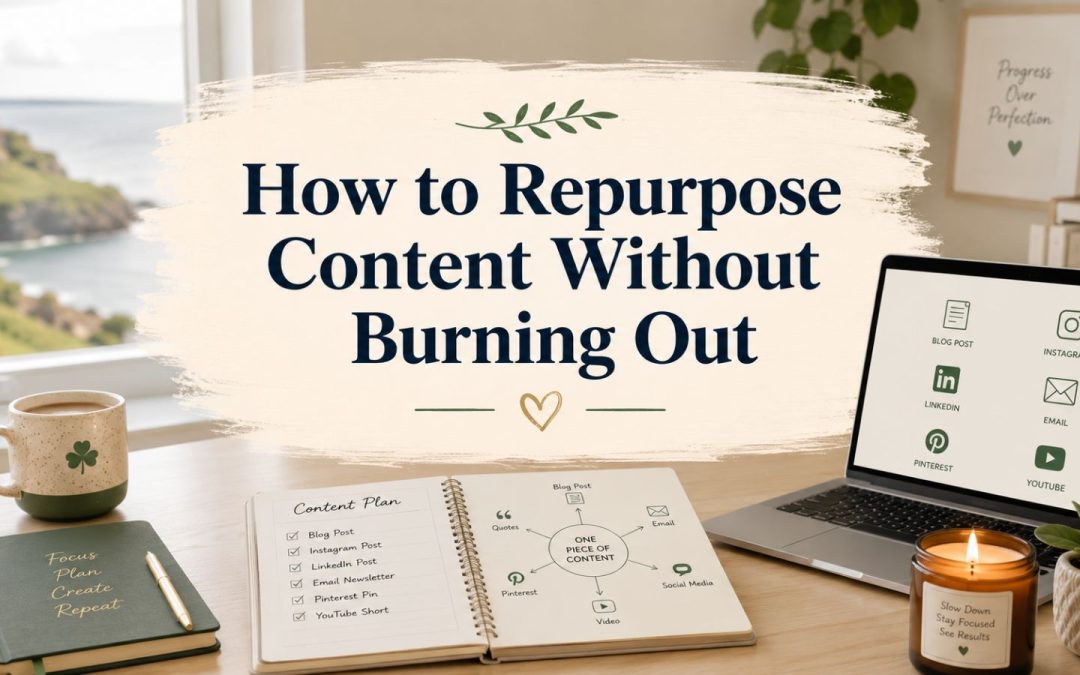
How to Repurpose Content Without Burning Out
52% of content creators say they’ve experienced burnout from the work, and 37% are considering walking away from it entirely, according to research from Billion Dollar Boy. For a small business owner who creates content on top of running the actual business, that number isn’t surprising. It’s a warning.
Most people don’t burn out because content marketing is hard. They burn out because they’re making everything from scratch, every single time, on five platforms at once. Learning how to repurpose content is the fix, but only if you do it in a way that subtracts work instead of adding it. Done wrong, repurposing becomes one more plate to spin. Done right, it’s the difference between a content habit that lasts and one that quietly collapses by month two. This guide is about the sustainable version.
Why creating from scratch is what actually burns you out

The exhaustion rarely comes from one big task. It comes from the constant low-level demand to think of something new. A blank page on Monday for LinkedIn, another for Instagram, another for the newsletter. Each one asks you to invent, not just publish.
You’re not alone in feeling it. Over half of marketers, 50.8%, reported emotional exhaustion in the past year, with 58% feeling overwhelmed by the sheer number of channels they manage, according to Marketing Week. When you’re a team of one, that overwhelm hits harder, because there’s nobody to hand the next post to.
Here’s the trap underneath it. Owners believe more content means more reach, so they chase volume. But producing six original ideas a week isn’t a content strategy, it’s a part-time job you didn’t agree to. The work becomes about feeding the platforms rather than serving the customer, and that’s the exact point where it stops being sustainable.
The mindset shift: one idea, many formats
The whole problem flips when you stop thinking in posts and start thinking in source material. You don’t need a new idea for every platform. You need one good idea, captured once, then reshaped for wherever your audience already is.
This is what repurposing actually means: taking a single piece of substantial content, your “anchor”, and turning it into several smaller pieces. One ten-minute video becomes three short clips, a written article, four social posts, and an email. You had the idea once. You said it once. Everything after that is reshaping, not reinventing, and reshaping is where the burnout stops.
It also fixes the consistency problem at the same time. Around 60% of marketers say producing content regularly is a genuine challenge, according to DesignRush. Consistency is hard when every post needs a fresh idea. It gets easy when one recording carries your whole week. You’re no longer asking “what do I post today?”, you’re asking “what did I already make, and where else can it go?”
A repurposing rhythm that survives a busy week
Sustainability lives in the routine, not the effort. Here’s a weekly loop built for someone who is also doing the real job. The point is to remove the decisions, because decisions are what drain you.
- Create one anchor a week (about 45 minutes). Record one video, talk through one topic as a voice note, or write one short article. This is the only thing you make from scratch all week. Pick a question your customers actually ask, so the effort serves the business, not just the feed.
- Pull the smaller pieces from it (about 30 minutes). From that single anchor, draw out the short-form content: a few social posts, an email, a quote, a clip. You’re harvesting what’s already there, not starting over. The full breakdown of which formats to pull lives in our guide to the ways to repurpose content from one source.
- Let AI do the reshaping (about 20 minutes). Hand your anchor to a tool like Claude or ChatGPT with a clear instruction, and let it draft the social posts and email from your actual words. This is the part that removes the grind. Our walkthrough on building an AI content workflow shows exactly how to set this up so the output sounds like you and not like a robot.
- Schedule it and step away (about 15 minutes). Load the week into a scheduler so publishing never depends on you having a free moment. This single habit is what protects your cadence through the weeks when client work takes over. A queue can’t burn out.
The first week feels like setup. By week three it’s a routine that runs on rails, and the dread that used to sit on Monday morning is gone, because the hard thinking is already done.
The limits that keep repurposing sustainable
Repurposing can quietly turn into its own source of burnout if you let it become a maximising game. The goal is more reach from less effort, not endless output. A few boundaries keep it healthy.
Don’t repurpose onto every platform at once. Just because one video can become content for seven channels doesn’t mean it should. Pick the two or three platforms where your customers actually are and serve those well. Managing seven feeds is the overwhelm Marketing Week measured, repackaged.
Don’t dilute the anchor. If you stretch one thin idea into fifteen pieces, your audience feels the padding. Better to make one genuinely useful anchor and reshape it into five strong pieces than to wring a weak one dry.
Don’t chase daily. Three good posts a week you can sustain beats a daily schedule you’ll abandon. Consistency over months is what compounds, and you only get months if the pace is survivable.
Pro tip: Re-run your best anchor every quarter. The content that worked once will usually work again, because most of your audience missed it the first time and the rest have forgotten. Trying to be original every single week is the very pressure that ends most content habits. Permission to reuse is permission to keep going.
If you want the visibility side of this dialled in too, our guide to an organic social media strategy covers the cadence and content mix that pair with a repurposing system. Both sit inside the bigger picture of content marketing for small business, which ties the whole approach together.
What to expect when you switch to repurposing

Don’t expect the workload to vanish overnight. The first two or three weeks feel like effort, because you’re building the rhythm and learning to think in anchors instead of posts. That’s normal, and it’s temporary.
What you should expect after that is a real drop in the mental load. The same volume of content, sometimes more, for a fraction of the weekly stress. Fewer blank pages, fewer panicked Sunday-night sessions, and a feed that stays alive even through your busiest stretch. That’s the part that lasts. The owners who stick with content marketing aren’t the ones with the most discipline. They’re the ones who built a system light enough that discipline stopped being the deciding factor.
Frequently asked questions
What does it mean to repurpose content?
Repurposing content means taking one substantial piece, such as a video, article, or podcast, and reshaping it into multiple smaller formats for different platforms. One recording can become short clips, a blog post, several social posts, and an email. You create the core idea once, then adapt it, instead of inventing something new for every channel.
How does repurposing content prevent burnout?
It removes the constant demand to think of new ideas, which is the main driver of content burnout. Instead of producing six original pieces a week, you create one anchor and reshape it. That cuts the mental load dramatically while keeping you consistent, so your content habit survives busy weeks instead of collapsing under them.
How often should a small business create new content?
For most small businesses, one substantial anchor piece a week is enough. From that single source you can produce a week of social posts, an email, and clips through repurposing. The aim is a pace you can sustain indefinitely, because consistency over months is what builds results, not short bursts of high output.
Can AI help me repurpose content?
Yes, and it’s where AI saves the most time. Tools like Claude or ChatGPT can take your anchor piece and draft the social posts, email, and summaries from your own words in minutes. You stay the source of the ideas; AI handles the reshaping, which is the repetitive part that usually causes the fatigue.
Build the system, not the willpower
Learning how to repurpose content isn’t about producing more. It’s about protecting the one resource a small business can’t outsource: your energy. Create one anchor a week, reshape it where your customers are, set the limits that keep it sustainable, and let consistency do its slow work.
If you’d rather build this rhythm alongside other owners doing the same, with templates and feedback so it sticks past the first month, join our membership and set up a content system that doesn’t burn you out.