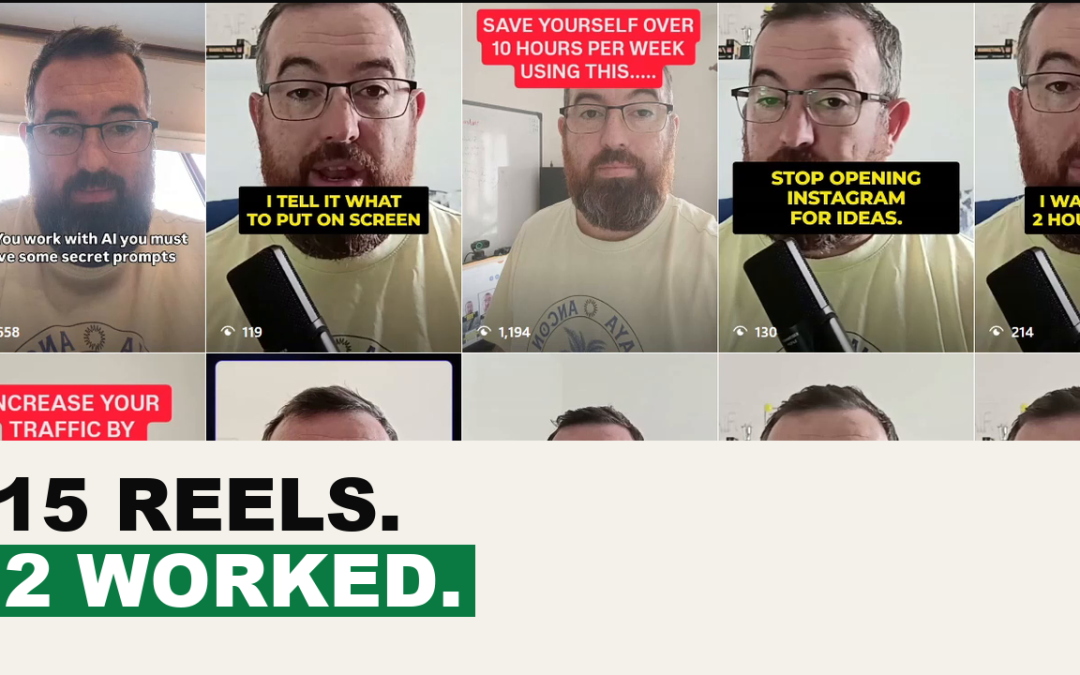
I made fifteen reels in one day. Two of them got real views. The other thirteen went nowhere.
That is the honest number, and I am starting with it because almost nobody publishing advice on this will tell you theirs. If you are asking why are my reels not getting views, the first thing worth knowing is that most reels do not get views, including mine, including the ones made by people who do this for a living. The question is not how to make every reel land. It is how to find the two that will.
My own view counts are not great. I will say that before you go and check. What changed for me was not a trick or a posting time. It was accepting that a reel is a test, and that a test only tells you something if you run enough of them and change one thing at a time.
The real reason most reels get no views
Your followers are not the audience. That sounds wrong, so here is the mechanism.
Instagram is blunt about how the reels feed gets built. In its own words, "much like Explore, the majority of what you see is from accounts you don't follow." The reels tab is a discovery surface. It is not a feed of the people you have chosen to follow, and it was never designed to be.
That has a consequence people miss. When a reel gets no views, it usually did not get rejected by your followers. It never got shown to strangers in the first place. You are not being punished. You simply did not clear the bar that gets content pushed out to people who have never heard of you.
Instagram lists the signals that decide that, roughly in order of importance:
- Your activity, meaning which reels you have liked, saved, reshared and commented on recently
- Your history of interacting with the person who posted
- Information about the reel itself, including the audio track, the visuals and its popularity
- Information about the person who posted
Read that list from the position of a stranger rather than your own. For someone who has never seen you, signals one and two are worth nothing. They have no history with you. All that is left is the third one, the content of the video itself, and how quickly it holds someone who has zero reason to care.
That is why the reel with your best information in it can flop while a throwaway one takes off. The algorithm is not judging the value of your advice. It is judging whether a stranger stayed.
Fifteen in a day, and why that number matters
Here is what I actually did. One afternoon, in a yellow t-shirt I have since retired, I recorded and posted fifteen short videos. Different hooks, different opening frames, different topics. By the end of the week two of them had views worth talking about and thirteen had close to nothing.
A year earlier I would have called that a bad day. It is not. It is the only way I have found to get information out of a platform that will not tell you anything useful from a single post.

One reel gives you no data. If it flops you cannot tell whether the topic was wrong, the first second was slow, the caption was flat, or it simply landed at a bad moment. If it does well you cannot tell why, so you cannot do it again. You have a result and no reason attached to it, which means you learn nothing and you post the next one on a hunch.
Fifteen gives you a spread. Two winners out of fifteen is a thirteen percent hit rate, and when you can see the two side by side against the thirteen, the difference between them stops being a mystery. That is the entire value of volume. Not reach, not the algorithm rewarding effort. Just enough results in one place that the pattern becomes visible.

If you are posting once a week and asking why your reels get no views, the honest answer may be that you do not have enough reels to know yet.
What actually changed on the two that worked
When I put the two winners next to the thirteen that went nowhere, the differences were not subtle.
Red text on the opening frame. Not the whole video, just the first thing on screen. Both winners had it. Most of the thirteen had white text or none.
Movement in the first second. Something in the frame moved before the words landed. The flops mostly opened on a static shot of me starting to talk.
A number in the hook. The single best performer opened with a specific figure rather than a claim. My most-commented post was one where the opening line carried a percentage rather than a promise. People stop for numbers, because a number implies someone actually measured something. A claim implies someone had an opinion.
None of that is a growth secret. It is three variables, and I only know they were the variables because everything else that day was held roughly constant. Same person, same room, same audio, same day, same account. That is what makes a batch a test instead of just a busy afternoon.
If you change the topic, the format, the length, the caption and the posting time all at once and one post does well, you have learned nothing you can repeat. This is the same mistake people make when they ask AI to fix ten problems at once and end up fixing none of them. One variable at a time is slower to feel and far faster to learn from.
Test with strangers before you spend your followers
The part that changed my approach most is a feature Instagram built for exactly this problem, and a lot of people either have not switched it on or have not understood what it is for.
Instagram describes trial reels as a way to "share reels with people who don't follow you" so you can see how content performs before deciding whether to push it further. A trial reel goes out to non-followers first. Your existing audience does not see it.
The mechanics are worth knowing precisely:
- Roughly 24 hours after posting, you can see views, likes, comments and shares on the trial reel
- You can share it to your followers manually with one tap once you like the numbers
- Or you can let Instagram share it automatically if it performs well "based on the views it receives within the first 72 hours"
That solves the thing that stops most owners testing properly, which is the fear of cluttering their feed with experiments. You are no longer spending your followers' patience to find out whether an idea works. You are spending strangers' attention, which is the audience that decides reach anyway.
Meta has published its own numbers on this. In an internal analysis of over 400,000 creators actively producing reels, Meta reported that "after trying trial reels, 40% of creators started posting reels more often and of those who did, 80% saw an increase in reels reach from non-followers." Meta attaches a plain disclaimer to that, which is that performance is not guaranteed, and it is worth taking seriously. That is a company reporting on its own feature. The mechanism is more convincing than the percentage: people who felt safe testing tested more, and testing more found more winners.
I keep about five trial reels running at any time. The ones that outperform get pushed to the main feed. The ones that do not simply stop, and nobody who follows me ever saw them.

The workflow I actually run
This is the part that makes the testing sustainable, because fifteen reels in a day is only repeatable if recording and editing are not the bottleneck.
Record in a batch. I sit down once and record ten to fifteen short videos on different topics, back to back. Same setup, same lighting, one session. The setup cost is paid once instead of fifteen times, which is the only reason the volume is possible at all.
Let AI do the edit. The edit is the part that used to stop me. Handing the raw footage to an AI edit takes the job that killed my consistency and removes it. I am not asking it to invent content or write my hooks. It is doing one narrow, boring job I do not want to do.
Run the batch as trial reels. They go to non-followers. I wait for the 24-hour numbers.
Promote the winners. Anything clearly outperforming gets shared to the main feed.
Schedule the rest properly. The pieces that earn their place go into a scheduling queue rather than being posted by hand, which is a separate problem with its own fix. I have written up the mechanics of that in how to automate social media posting.

Notice that every step removes one specific obstacle. Batching removes setup time. AI editing removes the edit. Trial reels remove the risk of testing in front of your audience. Scheduling removes the forgetting. None of them is trying to solve everything.
Fix one thing, not ten
The reason most people never get to the testing stage is that they try to fix their entire content operation in one go. New camera, new format, new posting schedule, new tool, new strategy, all in the same week. Then nothing improves in a way anyone can attribute to anything, and the whole effort gets abandoned.
Pick the one thing that is actually costing you. If you are not posting at all, the fix is batching, not hooks. If you are posting and getting nothing, the fix is testing, not volume. If you are testing and forgetting to publish, the fix is scheduling, not content.
I know which of those was mine because I could name it out loud: staying organised across every platform crucified me. Everything else was fine. So that is the only thing I fixed first, and the reels testing only became possible afterwards, because the admin stopped eating the time.
What working actually looks like on a small account
Set the expectation properly, because this is where most people quit.
Two winners from fifteen is not a disaster. At a small account, most reels reaching almost nobody is the default state, and a couple breaking out is the signal you are looking for. If you judge every individual reel as a pass or fail you will conclude the whole thing is broken within a fortnight. If you judge the batch, you get a hit rate, and a hit rate is something you can actually improve.
My views are still not where I want them. I am not going to pretend otherwise while telling you how this works. What has changed is that I now know which two things moved the needle on the ones that did land, and I have a way to find the next two without burning my feed to do it.
That is the whole method. Post enough to have data. Change one thing at a time. Test on strangers before your followers. Promote what wins.
Frequently asked questions
How many reels should I post before deciding my content is not working?
Judge a batch, not a post. Ten to fifteen recorded in one session gives you enough spread to compare winners against flops and see what separated them. A single reel that flops tells you nothing you can act on, because you cannot isolate which of the many variables caused it.
Do trial reels hurt my normal reach?
No, because they go to non-followers rather than your existing audience, and your followers do not see them unless you choose to share them. Instagram shows you the engagement numbers roughly 24 hours in, and will auto-share to followers based on views in the first 72 hours if you set it that way.
Why do my reels get views but no new followers?
Views and follows measure different things. The reels feed is largely strangers, so a view often means someone watched one video and moved on. A follow usually needs a reason to expect more of the same, which means a recognisable format, a clear subject and a profile that confirms what they just watched was not a one-off.
Should I delete a reel that got no views?
Not usually. A reel with no views has cost you nothing in front of your audience, and deleting it removes the record of what you tested. Keep it, note which variable it carried, and change one thing on the next one.
Is it worth posting reels if my account is small?
Yes, and it matters more at a small account than a large one, because the reels feed is mostly built from accounts the viewer does not follow. Having few followers is less of a handicap there than it is anywhere else on the platform. What holds small accounts back is usually not size, it is posting too infrequently to learn anything.
How do I know which variable actually made the difference?
Hold everything else steady. Record in one session so the room, the audio and the day are constant, then vary one deliberate thing across the batch, such as the opening frame, the text colour or the first spoken line. If several things change at once, a winner cannot tell you why it won.
If you would rather work through this with other owners doing the same thing than guess at it alone, you can join our membership. The testing habit is easier to hold when someone else is asking you what you learned this week.
Disclosure: Some links in this article are referral links. If you use one, I may earn a commission at no extra cost to you. I only link to tools I actually use.
How this was made: The facts, numbers and examples in this article come from my own work and videos. I use AI to help draft and structure the writing, then I review and edit every line myself before it goes live.

About the author
I'm Wayne St Ledger, and I run St Ledger Marketing. I started out in construction as a plasterer, then went on to a Bachelor's in Marketing and a Master's in International Business, which is where my bias toward results over talk comes from. I help business owners build marketing systems they actually understand, using AI in grounded, practical ways rather than hype. I also run a YouTube channel on marketing and AI, and The AI Marketing Hub, my own community for business owners and marketers putting AI to work properly.